
Deep groove ball bearings
6300 Series (medium) — Deep Groove Ball Bearings
The 6300 series shelf: 27 published designations, each with its own model-bound specification page. The ranges below are the span across exactly those published models — not a family-wide promise. Open a designation for its full table, or send the designation you need with your application details.
Last updated: 2026-11
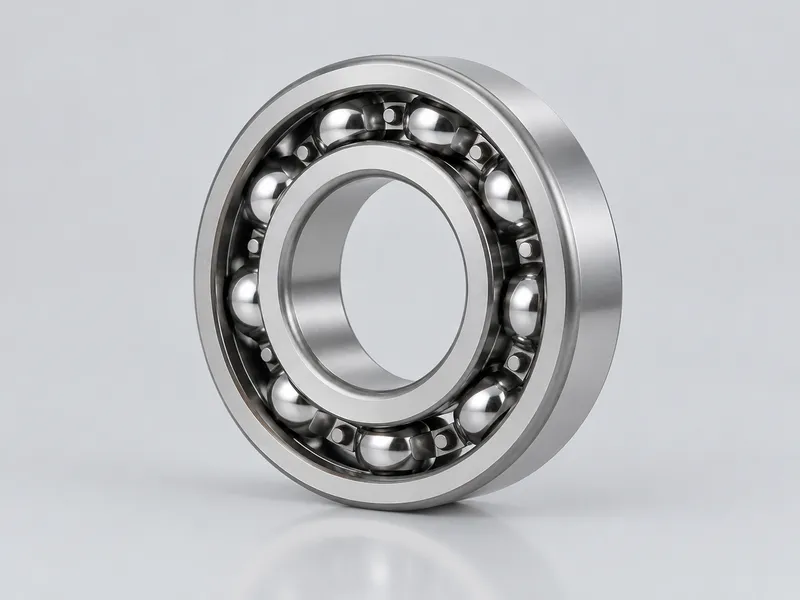
6300 series dimension and load range
| Attribute | Range across published models |
|---|---|
| Bore diameter (d) | 10 – 150 mm |
| Outside diameter (D) | 35 – 320 mm |
| Width (B) | 11 – 65 mm |
| Basic dynamic load rating (Cr) | 10.1 – 343 kN |
| Basic static load rating (C0r) | 3.45 – 284 kN |
Each span is the minimum and maximum over the 27 published model pages listed below, whose values are model-bound catalog figures traceable to a collected source. The series page adds no numbers of its own; a designation not listed here is not yet published with evidence, and we confirm it at quotation on request.
Published 6300-series models
Every designation below links to its own specification page — dimensions, load ratings, speeds and ordering notes per model.
Executions per designation
Designations published in more than one execution (open, ZZ shielded, 2RS sealed) share identical boundary dimensions — the execution is the sealing choice, not a different size. Open each variant for its own specification table and source list.
| Designation | Published executions |
|---|---|
| 6304 | open (6304) · ZZ shielded (6304 ZZ) · 2RS sealed (6304 2RS) |
| 6305 | ZZ shielded (6305 ZZ) · open (6305) |
Choosing inside the 6300 series
The 63 series is the heavy option of the standard deep groove line: at the same bore code it is physically bigger and carries more load than 62xx, and it is the step-up when one shaft has to carry more than the light series allows (Compel Group size-chart note, collected 2026-11-16). The extra steel is the entire proposition — more section for more capacity — and it arrives with two costs the buyer controls: housing space and a clearance answer that heavier fits stress harder.
What does stepping up to 6300 actually buy on the same shaft?
Capacity first: for a shared bore code the 63xx envelope is wider in both outside diameter and width, and that is where its higher ratings come from — same shaft, more steel (Compel Group, collected 2026-11-16). The second gain is quieter margins on marginal positions: a duty that sits near the top of a 62xx rating moves to real headroom instead of living on the limit. What it does not buy is drop-in fit — the step-up only exists where the housing can accept the larger envelope (Compel Group cross-reference note, collected 2026-11-16).
Will a 6300 fit where a 6200 was running?
Not in the same housing bore: the larger outside diameter and width mean a 63xx will not drop into a housing cut for 62xx, and the reverse swap fits but gives up the capacity the position was sized around (Compel Group, collected 2026-11-16). A series change on an existing machine is a housing-bore decision first — it needs re-machining or a housing already sized for the new envelope, and the existing bearing's outside diameter should be measured before any cross-series replacement is ordered (Fuli Bearings, collected 2026-11-16).
Does the heavier section change the clearance answer?
It raises the stakes rather than changing the rule: heavier duty tends to come with heavier interference fits and larger temperature differentials, and both close clearance in service — which is why the classes above C3 exist for both-rings-interference fits and large temperature differentials (Fabrico clearance-class guidance, collected 2026-11-16). Two cautions carry over unchanged: clearance is not quality — a bigger class letter is a bearing that expects to lose more clearance, not a stronger one — and the same class label corresponds to bigger numbers as the bore grows, so read the row for the actual bore, never the class alone (Fabrico, collected 2026-11-16).
What does the wrong fit cost on a heavy-duty position?
On this series the load that made you pick 63xx also attacks the fit: a radial load beyond a quarter of the static rating reduces the effective interference, so the same load that justifies the heavy section demands a tighter fit than a light-duty position would take — and impact loads demand much greater interference still (JTEKT fit-selection guidance, collected 2026-11-16). A fit chosen without that margin loses grip exactly as the duty gets hardest, which is why heavy positions are fitted from load-rotation rules and load magnitude together rather than copied from a lighter machine. The heavier the position, the less the fit is a formality.
How often will regreasing fall due on a 63xx position?
The heavier section buys capacity, but it does not buy grease life: the interval follows speed, bore, temperature and environment (EASA motor-lubrication guidance, collected 2026-11-16), and the standard worked example lands exactly in this series — a 6314 at 1780 rpm reads about 11,000 hours under normal conditions, with the bore worked out from the designation itself and the nearest-smaller curve used where the exact bore is not on the chart (EASA, collected 2026-11-16). The same source halves the figure for vertical mounting, belt load or hostile environment, so a 63xx fan bearing in a dirty plant can owe grease four times as often as its rating suggests. On a heavy position that is hard to reach for service, the relubrication schedule is a real ownership cost — worth pricing against the lighter alternative before the envelope is committed.
Does the heavy section ever justify paying for a higher precision class?
Rarely, and only from the shaft's requirement: the tolerance class is determined by the rotation accuracy the shaft must have at the support point, translated through the one-to-one ABEC-to-ISO/DIN/JIS class mapping (ISK Bearing precision-grade guidance, collected 2026-11-16). Higher classes exist for high-speed spindle work, and the ratings themselves do not state speed limits or noise performance at all (GlobalSpec bearing-tolerances explainer, collected 2026-11-16). A 63xx position is usually chosen for load at moderate speed — which puts it in the class range most bearings are sold in — so the honest trigger for an upgrade is a written rotation-accuracy requirement from the driven machine, not the weight of the section.
Read the bore-code row in the range table for the exact envelopes at your shaft size, then budget the housing for the larger envelope and fix the clearance class against the real fits and temperature. Each published 63xx model below carries its own evidence-backed ratings.
For the type-level overview see the deep groove ball bearings family page, or the standard model index for every published designation across all families.
Failure modes in service — 6300 series
The medium 6300 series takes the loads the light series was avoiding — which moves its dominant failure modes one step downstream: heavier dynamic loads make cage dynamics and clearance management decisive, and the equipment that runs 63xx bearings (gearboxes, larger motors, fans, compressors) is exactly where misalignment, thermal clearance loss and lubrication neglect show up first.
Fretting corrosion and false brinelling
Under heavier loads the fit rules tighten: a fit that is marginal for the load lets the loaded ring microslip on its seat, destroying the interface lubricant film and producing the reddish-brown oxide debris of fretting corrosion — on the inner-ring bore or outer-ring OD, with matching wear and discoloration on the shaft or housing. Because fretting corrosion concentrates stress at the ring surface, it is a documented primary pathway to ring fracture: on a medium-series bearing carrying real load, reddish dust at the seats is a ring-cracking risk, not a housekeeping issue.
In the rolling contact, false brinelling — depressions at rolling-element pitch in a stationary, loaded bearing, formed by cyclic vibration breaking through the lubricant film — applies to any 63xx position that stands still under load while its machine or its transport vibrates: spare machines in transit, standby pumps run as installed spares. The distinction to remember when inspecting: reddish debris and pitch-spaced dull marks mean standstill vibration; clean, sharp metallic indentations mean a true brinelling shock, typically from impact mounting.
Electrical erosion (fluting)
Current through a rolling bearing damages the contact the same way regardless of bearing size: at each discharge the material is tempered, re-hardened or melted, leaving craters; continuous low-intensity leakage — the inverter-motor case — erodes thousands of micro-craters that line up into fluting, the washboard pattern running transverse to rolling direction (SKF and Schaeffler damage documentation; ISO 15243 mode). Larger 63xx-bearing motors run more often on drives, and the documented field pattern is consistent: without shaft grounding, drive-driven bearings commonly fail well short of calculated life, and no grease change prevents it.
The countermeasure set is electrical and specified at selection: insulated or ceramic-hybrid bearing on the affected end, shaft grounding ring, correct earthing — with the grounding ring kept as part of the package, because insulating both ends can shift the discharge into the coupled machine. State the drive duty when requesting a quote for a 63xx motor position.
Cage fracture
The heavier the series, the more energy its cage manages. Rapid speed changes — equipment whose RPM swings up and down — subject the cage to high inertial loads and can fatigue it to functional end-of-life even with no raceway spall; the documented fix is supplying a more robust cage design, a selection-time decision. The other documented drivers of cage fracture are the classics: operation beyond design speed, inadequate lubrication raising friction and cage wear, contamination wedged into the pockets, and mounting that stressed the cage. A broken cage is a secondary failure: the balls bunch and skid and the bearing is finished quickly, but the root cause lives in the history, not the debris.
This is why the per-model limiting speeds on the linked 63xx pages are hard ceilings for standard executions: pushed past them without precision-class measures (accuracy class, oil-air or circulating lubrication, adapted clearance, accurate seats), cage failure and seizure are the documented outcomes. If your duty genuinely needs more speed than the table allows, that is a different bearing conversation, not a tolerance on this one.
Lubrication and contamination
At 63xx section heights, grease life mathematics get less forgiving: grease time-to-failure typically halves as speeds approach the grease DN limits, and larger bearings shorten grease life further — partly because centrifugal force throws grease off the cage and raceway surfaces where it is needed. The standard failure entries follow: missed regreasing (lubricant loss), wrong grease type for the duty (EP vs non-EP is a real fork), over-greasing overheating the bearing (chiefly open executions), and degradation — base-oil separation, oxidation, hardening — accelerated by operating temperature.
Contamination acts on the medium series both directly and statistically: hard particles dent raceways into early-spalling stress concentrations, moisture emulsifies grease and corrodes, and contamination-degraded lubricant fails without leaving dramatic dents — which is why motor-failure statistics count contamination directly in roughly 15% of cases and estimate up to about 30% once lubricant failures caused by contamination are included (SKF Evolution). For 63xx positions in dirty duty, the sealed and shielded executions of these designations are the first line of defence; their grease still ages, so interval discipline continues.
Fits, mounting and thermal clearance
The medium series concentrates the clearance story. Operating temperature is not neutral: the inner ring, riding the warm shaft, expands faster than the outer ring in its heat-shedding housing, so internal clearance shrinks in service — and a fit-plus-clearance combination chosen without enough operating margin ends in negative clearance: preload, drastic life reduction, excessive heat and potential seizure. High-ambient and continuous-duty 63xx applications are exactly where the C3-class questions belong; the per-designation clearance execution is a quote-time confirmation, not an assumption.
Fit and alignment failures complete the set: a too-tight fit heats the bearing; a too-loose one lets the ring creep, leaving fretting corrosion on the shaft journal that must be repaired before the next bearing is fitted — new bearing, old seat, same failure. And the calculated ratings assume the near-zero misalignment of a correctly aligned train (around 0.0005 rad): beyond that, edge loading puts a fraction of the raceway to work and life falls below calculation, with the vibration and noise to warn you. Mount with a press or induction heater, never hammer force, and the mounting stage stops being a failure source.
Root-cause chains and photographic identification for every mode above are in our failure-modes overview and the photo-based root-cause guide; mounting practice has its own best-practice page. Each designation above links to its model-bound page for the dimensions, ratings and speed ceilings these checks apply to.
SKF 6308-2Z — exact load ratings, shielded speed limit and mounting envelope
This block is specific to SKF 6308-2Z, the double-shielded SKF Explorer execution of the 6308 size. Do not transfer its values to an open 6308, 6308-2RS contact-sealed bearing or another manufacturer's 6308ZZ. SKF identifies the shields as non-contacting; they are not liquid-tight contact seals.
| SKF 6308-2Z field | Manufacturer-published value | Buyer interpretation / boundary |
|---|---|---|
| Boundary dimensions | d × D × B = 40 × 90 × 23 mm | Nominal shaft, housing and axial-space envelope |
| Basic dynamic load rating | C = 42.3 kN | Basic catalogue rating; not an application-specific allowable load or life result |
| Basic static load rating | C₀ = 24 kN | Use with the actual equivalent static load and required static safety factor |
| Fatigue load limit | Pᵤ = 1.02 kN | SKF calculation input; not a permissible minimum external load by itself |
| Limiting speed — 2Z | 8,500 r/min | Use the double-shielded column for this exact execution; do not substitute the open-bearing value |
| Open 6308 speed reference | 11,000 r/min limiting speed | SKF's speed table lists this for open 6308, not for 6308-2Z |
| Reference speed | 17,000 r/min | A separate catalogue reference value, not the 2Z limiting speed or an unconditional operating target |
| Internal clearance / precision | CN; P6 dimensional tolerance class | Do not assume C3 or infer an individual bearing's measured clearance |
| Cage / lubrication | Sheet-metal cage; grease; no relubrication feature | SKF's product record does not state grease chemistry or fill mass here |
| Shielding | 2Z, shields on both sides; non-contacting | Solid-contaminant shielding; not a contact seal or a liquid-tight washdown barrier |
| Shaft abutment | da = 49–56 mm | SKF's shaft-shoulder diameter range for the exact product |
| Housing abutment | Da max. = 81 mm | Maximum housing-shoulder diameter |
| Corner / bearing chamfer | ra max. = 1.5 mm; r₁,₂ min. = 1.5 mm | Check mating fillet against the bearing chamfer; these do not define shaft or housing bore tolerances |
| Dimensional deviations | Bore −0.010 to 0 mm; outside diameter −0.013 to 0 mm; ring width −0.06 to 0 mm | Bearing-ring deviations, not shaft-journal or housing-bore tolerances |
| Calculation factors | kᵣ = 0.03; f₀ = 13.2 | Manufacturer calculation inputs; not stand-alone selection limits |
Why the 2Z speed limit matters
SKF's 6200/6300-series speed table, printed page 9, lists 6308 at 8,500 r/min in the double-shielded limiting-speed column and 11,000 r/min in the open-bearing column; its note assigns double-shielded 2Z bearings to the shielded column. The product page separately lists 17,000 r/min as reference speed. These are three different catalogue fields: for an SKF 6308-2Z shortlist, 8,500 r/min is the published limiting-speed figure to compare with the required speed. Actual operating speed still depends on load, lubrication, heat generation, fit and the application.
The 2Z shields are non-contacting and should not be selected as a substitute for contact seals where liquid ingress or aggressive washdown is expected. The listed 42.3 kN and 24 kN ratings are basic dynamic and static ratings, not a ready-made allowable load. Select shaft and housing fits only after identifying the rotating ring, load direction, temperature gradient and required clearance after mounting. Confirm the complete suffix and actual supply manufacturer on the quotation.
Sources: SKF 6308-2Z official product page (exact dimensions, C, C₀, Pᵤ, reference/limiting speeds, CN, P6, cage, shields, lubrication, dimensional deviations and abutment dimensions); SKF Speed ratings (RPM), 6200 & 6300 series, printed p. 9 (6308 double-shielded, open and reference-speed columns and 2Z note).