
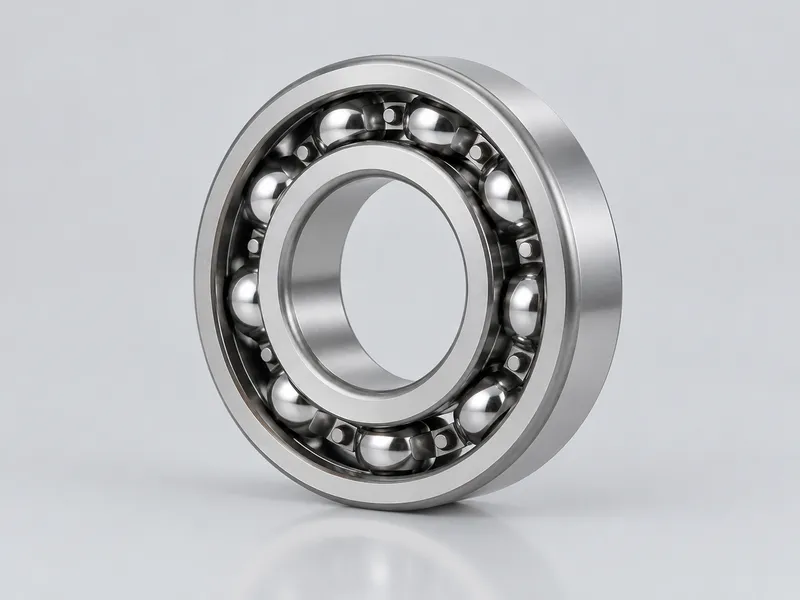
Deep groove ball bearings
6200 Series (light) — Deep Groove Ball Bearings
The 6200 series shelf: 27 published designations, each with its own model-bound specification page. The ranges below are the span across exactly those published models — not a family-wide promise. Open a designation for its full table, or send the designation you need with your application details.
Last updated: 2026-11
6200 series dimension and load range
| Attribute | Range across published models |
|---|---|
| Bore diameter (d) | 10 – 150 mm |
| Outside diameter (D) | 30 – 270 mm |
| Width (B) | 9 – 45 mm |
| Basic dynamic load rating (Cr) | 6.4 – 220 kN |
| Basic static load rating (C0r) | 2.36 – 168 kN |
Each span is the minimum and maximum over the 27 published model pages listed below, whose values are model-bound catalog figures traceable to a collected source. The series page adds no numbers of its own; a designation not listed here is not yet published with evidence, and we confirm it at quotation on request.
Published 6200-series models
Every designation below links to its own specification page — dimensions, load ratings, speeds and ordering notes per model.
SKF 6205-2RSH/VA947 — food-line sealed execution and mounting dimensions
This is a manufacturer-specific 6205 execution, not a generic specification for every 6205 or 6205-2RS bearing. SKF describes 6205-2RSH/VA947 as a single-row deep groove bearing with contact seals on both sides and food-compatible grease, intended for food-processing lines in non-corrosive environments. The exact item data below is published by SKF for this suffix; it must not be transferred to another maker's 6205, another seal suffix or a standard 6205-2RSH.
| SKF 6205-2RSH/VA947 field | Published value | Buyer use / boundary |
|---|---|---|
| Boundary dimensions | d × D × B = 25 × 52 × 15 mm | Envelope for shaft and housing space check |
| Basic load ratings | C = 14.8 kN; C₀ = 7.8 kN; Pᵤ = 0.335 kN | Catalogue ratings, not application-specific allowable loads or life |
| Limiting speed | 8,500 r/min | SKF's published limiting speed for this sealed execution; do not substitute the open-bearing speed |
| Internal clearance / cage | CN; sheet-metal cage | Do not assume C3 or a polymer cage |
| Seal and lubricant | Contact seals on both sides; food-compatible grease; no relubrication feature | Sealed-for-life execution as listed; confirm actual food-contact rules and cleaning chemistry for the machine |
| Shaft shoulder diameter | da = 30.6–31.5 mm | SKF's published shaft abutment range for this exact item |
| Housing shoulder diameter | Da max. = 46.4 mm | Maximum housing abutment diameter |
| Fillet radius | ra max. = 1 mm; r₁,₂ min. = 1 mm | Check the shaft/housing corner against the bearing chamfer limit |
| Recess dimensions | d₂ ≈ 31.3 mm; D₂ ≈ 46.21 mm | Reference recess dimensions, not substitute shoulder limits |
| Temperature range | Not stated on the cited SKF product page | Do not infer a temperature limit from the food-compatible grease description |
SKF identifies this product as a food-line bearing for non-corrosive environments. That wording is not a blanket qualification for seawater, chloride exposure, aggressive washdown chemicals or every food-contact regulatory regime. Confirm the applicable cleaning medium, temperature, speed, load, required declarations and the exact suffix in the quotation. The published dimensions and ratings identify the SKF reference product; they do not confirm that this exact item is in stock or the manufacturer of every unit supplied against an inquiry.
Source: SKF 6205-2RSH/VA947 official product page (dimensions, load ratings, limiting speed, CN clearance, cage, double contact seals, food-compatible grease, shoulder and recess dimensions).
SKF 6206-2RS1 — exact mounting and dimensional-tolerance data
The figures below belong to SKF's exact 6206-2RS1 product record. They are not a generic tolerance or mounting table for every 6206, every 6206-2RS execution or another manufacturer's equivalent designation. Use the dimensional deviations and abutment limits to check a drawing; they do not by themselves prescribe a shaft or housing fit, because the fit also depends on load direction, rotating ring, operating temperature and required internal clearance.
| SKF 6206-2RS1 field | Published value | Buyer / drawing check |
|---|---|---|
| Boundary dimensions | d × D × B = 30 × 62 × 16 mm | Nominal envelope for shaft and housing space |
| Bore diameter deviation | tΔdmp = −0.008 to 0 mm | SKF published mid-range bore-diameter deviation; not a shaft tolerance |
| Outside diameter deviation | tΔDmp = −0.011 to 0 mm | SKF published mid-range outside-diameter deviation; not a housing-bore tolerance |
| Ring width deviation | tΔBs = −0.06 to 0 mm | Axial width tolerance for the bearing ring |
| Reference geometry | d₁ ≈ 40.36 mm; D₂ ≈ 54.06 mm; r₁,₂ min. = 1 mm | Shoulder / recess reference diameters and minimum bearing chamfer |
| Shaft abutment diameter | da min. = 35.6 mm; da max. = 40.3 mm | Use the range to check the shaft shoulder against the bearing face |
| Housing abutment diameter | Da max. = 56.4 mm | Maximum housing shoulder diameter |
| Corner radius | ra max. = 1 mm | Maximum shaft / housing fillet radius; keep distinct from the bearing's 1 mm minimum chamfer |
| Geometrical run-out | tKia max-range = 8 μm; tKea max-range = 13 μm; ISO geometrical tolerance class P6 | SKF's listed assembled-bearing section-height ranges and class; not a blanket P6 guarantee for every substitute |
| Basic load ratings | C = 20.3 kN; C₀ = 11.2 kN; Pᵤ = 0.475 kN | Catalogue ratings, not application-specific allowable loads or life |
| Limiting speed | 8,000 r/min | SKF's published value for this sealed 6206-2RS1 execution; do not replace it with an open-bearing reference speed |
| Calculation factors | kᵣ = 0.025; f₀ = 14 | Manufacturer calculation data; not standalone selection limits |
The abutment diameters and corner radius are geometric limits, not a complete mounting prescription. Select shaft and housing tolerances only after identifying which ring carries the rotating load, the load magnitude and direction, temperature gradients, required clearance after mounting and the actual housing construction. Do not subtract the bearing's dimensional deviations from a nominal shaft size and call the result a recommended fit.
Source: SKF 6206-2RS1 official product page (dimensions and deviations, abutment dimensions, run-out tolerances, load ratings, limiting speed and calculation factors).
NSK 6205C3-APN — original radial internal-clearance range
NSK identifies the exact 6205C3-APN product as a 25 × 52 × 15 mm single-row deep-groove ball bearing with C3 radial internal-clearance class. NSK's technical catalog Table 8.10 places its 25 mm bore in the “over 24 to 30 mm” row. The limits below are the manufacturer's unmounted, theoretical radial internal-clearance ranges for that bore band; they are not measured values for an individual bearing or guaranteed residual clearance after installation.
| NSK clearance class, 24–30 mm bore band | Radial internal clearance (μm) | How it relates to 6205C3-APN |
|---|---|---|
| C2 | 1–11 | Smaller-than-normal reference band; not the listed execution |
| CN | 5–20 | Normal-clearance reference band for the same bore range |
| C3 | 13–28 | Exact clearance class stated on NSK 6205C3-APN product record |
| C4 | 23–41 | Greater-than-C3 reference band; not the listed execution |
| C5 | 30–53 | Greater-than-C4 reference band; not the listed execution |
Measurement correction: NSK Table 8.10 states that measured radial clearance is slightly larger than theoretical clearance because of elastic deformation under the measuring load. For a 18–50 mm bore, the catalog's 49 N measuring-load correction for C3 is 6 μm. When comparing a 6205-size C3 measurement made under that specified load with the theoretical table, subtract the 6 μm correction; do not treat the uncorrected gauge reading as the theoretical clearance range.
Mounted-clearance boundary: the 13–28 μm C3 range is the pre-mount reference, not the remaining operating clearance. NSK describes residual clearance as the initial clearance reduced by the effects of the inner-ring/shaft fit and outer-ring/housing fit; effective clearance is then further affected by the temperature difference between rings. A C3 suffix alone therefore does not determine the installed or running clearance. Confirm the actual fit, ring temperatures, load, speed and required operating clearance for the assembly.
The range is selected by the 25 mm bore falling in NSK's 24–30 mm band; it must not be transferred to another bore size, another maker's 6205C3, or a different clearance suffix. The adjacent CN/C2/C4/C5 rows are catalog comparison bands, not claims that those variants are the exact NSK 6205C3-APN product.
Sources: NSK 6205C3-APN official product record (designation, 25 × 52 × 15 mm envelope and C3 class); NSK Rolling Bearings for Industrial Machinery, Part A, Table 8.10, printed p. A169 (clearance limits and measuring-load correction), and Fig. 8.8, printed p. A175 (fit/temperature effects on radial clearance).
Executions per designation
Designations published in more than one execution (open, ZZ shielded, 2RS sealed) share identical boundary dimensions — the execution is the sealing choice, not a different size. Open each variant for its own specification table and source list.
| Designation | Published executions |
|---|---|
| 6204 | open (6204) · ZZ shielded (6204 ZZ) · 2RS sealed (6204 2RS) |
| 6221 | open (6221) · 2RS sealed (6221 2RS) |
| 6222 | open (6222) · 2RS sealed (6222 2RS) |
| 6224 | open (6224) · 2RS sealed (6224 2RS) |
| 6226 | open (6226) · 2RS sealed (6226 2RS) |
| 6228 | open (6228) · 2RS sealed (6228 2RS) |
Choosing inside the 6200 series
The 62 series is the default of the standard deep groove line: it covers most general machinery, and where only the shaft is fixed and the housing is still open, guidance converges on picking 62xx and stepping away only for a tighter housing (60) or a heavier load (63) (Fuli Bearings series-selector guidance, collected 2026-11-16; Compel Group size-chart note, collected 2026-11-16). A default is only useful if you can say when it is wrong, which is what the questions below fix.
When is the 6200 default the wrong series?
Wrong in both directions for concrete reasons: a housing bore already machined for a 63xx envelope cannot take the smaller outside diameter as an upgrade without rework, and a tight housing or a light, speed-critical duty wastes the 62xx section that a 60xx would serve (Fuli Bearings, collected 2026-11-16). The default is a starting point keyed to general-purpose duty, not a rule that survives every housing drawing — measure the existing outside diameter before ordering any replacement outside the series (Fuli Bearings, collected 2026-11-16).
What clearance suffix should the designation carry?
Match the class to the fits and the heat, not to habit: CN suits positions where one ring is clamped, the other slides, and the machine runs near ambient; C3 is the answer when the inner ring gets a press fit, the machine runs warm, or the driven-equipment manufacturer specifies it — the interference fit and the hotter inner ring both eat clearance in service (Fabrico clearance-class guidance, collected 2026-11-16). Ordering C3 everywhere "to be safe" is its own failure mode: on a loose-fitted, cool-running position the extra play just raises vibration and noise (Fabrico, collected 2026-11-16). Whichever class you land on, write the suffix into the work order and the spare-part record — a designation stored without its clearance class gets replaced by whatever is on the shelf (Fabrico, collected 2026-11-16).
Open, shielded or sealed for a general-purpose position?
Follow the dirt and the temperature, in that order: ZZ where the space is clean and dry or the duty runs fast or hot; 2RS where fine dust, splash or wash-down water can reach the bearing and the speed is moderate (Qogori closure guidance, collected 2026-11-16). Open bearings stay right where a housing lip seal or circulating oil already does the sealing — in fact a double seal there can block the oil the position depends on (Qogori, collected 2026-11-16). And note what the closure does to service life on this series: pressed-in shields and sealed-for-life executions cannot be regreased in service, so a duty that needs routine relubrication wants open or removable-shield executions (Qogori, collected 2026-11-16).
Does a contact-seal designation qualify a 6200 bearing for high-pressure washdown?
No: “contact seal”, 2RS, DDU or LLU is not by itself a pressure-wash qualification. SKF documents a specific RSH design with a secondary lip whose contact pressure rises when external pressure is applied. Its published Kärcher-style test used hot water above 100 bar from the pump with both horizontal and vertical shafts; the nozzle distance depended on shaft orientation. SKF reports RSH improved water exclusion over its earlier RS1 seal specifically under high-pressure water impact. This is a maker-specific design and test result, not a universal pressure rating for every 2RS bearing or every size (SKF, “New sealing solutions for deep groove ball bearings”, 21 August 2003, “RSH designs” and “Sealing test program”; Publication 6270 EN, June 2006, printed pp. 3–4 and Table 3, p. 6).
The other manufacturers’ published descriptions do not use that same test protocol. NSK describes its DDU rubber contact seal as having “good” water resistance when fluid is splashed on the bearing (CAT. No. E1103, Part C, Table 1, printed pp. C010–C011). NTN rates LLU water proofing “very good” and LLH “good”, while distinguishing their torque and speed trade-offs (CAT. No. 2203-3/E 24.09.00, Table 1, printed p. B-17). Schaeffler rates HRS and ELS water-ingress performance “++” (“very good”) on its own qualitative scale (TPI 165, “Characteristics of sealing variants”, printed p. 5). These descriptions are useful for shortlisting, but their labels are not a common test scale: none of those cited tables gives a pressure, nozzle distance, water temperature or exposure cycle comparable to SKF’s published test.
For pressure-washdown duty, specify the exact manufacturer, full bearing designation and seal execution, then require evidence for that exact size and execution under the machine’s cleaning conditions. Ask for pressure at the pump and nozzle, nozzle distance and angle, water temperature, flow, exposure time and cycle, shaft orientation and whether it is rotating, plus detergent chemistry and operating temperature. Do not accept “2RS equivalent” or a generic “water resistant” statement as proof of high-pressure washdown suitability. If the duty is splash rather than pressure washing, the manufacturers’ qualitative descriptions can help shortlist candidates, but they still do not prove chemical compatibility or a common ingress rating.
The SKF range itself is size- and edition-dependent: Publication 6270 EN (June 2006) lists the 62-series RSH range only through 6205 in Table 3, while SKF’s 20 July 2017 update says RSH availability was extended up to 60 mm bore in the 62 and 63 series. Confirm the exact current SKU rather than transferring an old range table to every 62-series size (SKF, “Added versatility as use of RSH heavy-duty seals is extended”, 20 July 2017).
When does the fit need to be tighter than the usual chart pick?
When the load is heavy enough or hot enough to eat the interference: a radial load above a quarter of the static load rating reduces the interference in service because the inner ring expands under load, which is why heavier loads call for greater interference, and impact loads call for much greater interference still (JTEKT fit-selection guidance, collected 2026-11-16). Temperature works the same direction — an inner ring running hotter than its shaft loses effective interference as it grows (JTEKT, collected 2026-11-16). This is the mechanical reason the clearance-class answer above keeps pointing at the real fit and the real temperature: a press fit on a warm position does not just close clearance, it also thins the grip of the fit itself, so fit and clearance have to be chosen against each other, not separately.
How often will this position need regreasing — and what halves the interval?
There is no single answer to carry on the drawing: relubrication frequency depends on operating temperature, shaft speed, bearing size, load, hours of operation, contamination and vibration, and where the motor manufacturer gives no instruction the interval is read from speed-and-bore charts for normal conditions (EASA motor-lubrication guidance, collected 2026-11-16). The adjustment rule is the part buyers routinely miss: vertical mounting, belt pull, or a hostile environment each justify halving the chart interval (EASA, collected 2026-11-16). A 62xx position on a belt-driven fan in a dusty plant therefore lives on a much shorter grease cycle than the same bearing in a clean, direct-coupled motor — which is an argument for the closure and relubrication-path decisions above to be made together with the duty, not against the catalog default.
Does the default series ever need a precision class upgrade?
Only where the shaft demands it: the tolerance class should be determined by the rotation accuracy specified at the support point, and the ABEC ladder maps directly onto the ISO/DIN/JIS class systems, so a machine-tool or spindle-level requirement can be translated into a suffix rather than guessed (ISK Bearing precision-grade guidance, collected 2026-11-16). Most bearings sold sit in the two lowest classes — more than 98 percent — and the super-precision classes earn their cost in high-speed spindle duty, not in general machinery (GlobalSpec, collected 2026-11-16). Upgrading a general-purpose 62xx position "for quality" buys tighter dimensional tolerances the application cannot use, at a price premium the position never recovers.
Shortlist by bore code in the range table, then settle the two suffixes — clearance class and closure — against the real fits, temperature and contamination of the position. Both suffixes change how the same envelope behaves; the model pages below publish the executions evidence exists for.
For the type-level overview see the deep groove ball bearings family page, or the standard model index for every published designation across all families.
Failure modes in service — 6200 series
The light 6200 series is the volume workhorse of the deep groove plan — which is why most documented bearing failures happen to bearings exactly like these, in electric motors, fans, pumps and gearboxes. The five modes below account for the overwhelming majority of premature 62xx deaths, and none of them are visible on a specification table: they are set by fit, mounting, lubrication and the electrical environment.
Fretting corrosion and false brinelling
Two distinct damages get called "rust". False brinelling forms in the rolling contact of a stationary, loaded bearing under cyclic vibration: the lubricant film breaks down locally, corrosion and wear follow, and shallow depressions appear at rolling-element pitch — reddish or dull grey (SKF damage documentation). It is a storage and transport phenomenon as much as a service one: an idle machine vibrated during shipping can arrive with its 6205 already damaged at ball pitch.
Fretting corrosion proper lives at the seats: where a fit is too loose for the load, the ring microslips against shaft or housing, the interface lubrication is destroyed, and reddish-brown oxide debris forms — often mistaken for rust on the inner-ring bore or outer-ring OD. Beyond the mess, fretting corrosion concentrates stress at the ring and is a primary pathway to ring fracture, so reddish dust around the housing of a 62xx position is a stop-and-inspect signal, not a cosmetic finding. Matching wear on loose housing mounts amplifies vibration and masks the real defect severity, so bolt torque and housing seats belong in the same inspection.
Electrical erosion (fluting) in VFD-driven motors
The 6200 series is the default motor bearing, and VFD-driven motors are where its documented killer lives: stray shaft currents discharge through the lubricant film at each ball crossing, and the accumulated micro-craters machine the raceway into the parallel washboard pattern called fluting — classified as its own damage mode in ISO 15243 (current-leakage erosion), and unmistakable once inspected. Early evidence is grey fluting marks and a darkened, grey-black grease; noise and vibration rise from a bearing that was quiet when installed.
If the current path is not corrected, every replacement bearing follows the first — fluting is not cured by relubrication or by a better bearing of the same design. The documented countermeasure set is electrical: an insulated or ceramic-hybrid bearing on the affected end, a shaft grounding ring, and proper earthing of the motor. When requesting a quote for a 62xx position on a drive, state the drive duty; we will confirm the execution accordingly.
Cage fracture
A cage is not a load-bearing part: it spaces the balls. When one fractures, the primary failure is usually elsewhere — vibration during idle or storage, operation beyond design speed, inadequate lubrication raising friction, contamination wedged between cage and rolling elements, or mounting that stressed the cage — and once the cage goes, the balls bunch and skid, which is normally a fast path to total failure. The ISO 15243 damage classification treats cracking and fracture as a distinct mode precisely because it usually needs a root-cause investigation, not just a swap.
Two 62xx-specific duty checks: frequent starts (each one re-accelerates the cage through the balls) and rapid speed cycling, which loads the cage inertially and can fatigue it even without a raceway spall — the documented remedy is a more robust cage design, chosen at selection. And the limiting speed on each model page is a ceiling for standard executions: past it, cage failure and seizure are the expected outcomes, not a degraded L10.
Lubrication and contamination
Most premature failures in bearings of this class start with the lubricant: lost grease (missed or overdue regreasing), the wrong grease for the duty, over-greasing that overheats the bearing (mainly in open executions), and plain degradation — oil separating from the thickener, oxidation, hardening. Mixing incompatible grease types (a lithium-complex product over a polyurea one, for example) can break down the thickener within days, so grease type is logged at every top-up, not improvised at the machine.
Contamination is the second half of the story, and it is larger than the dents it leaves: foreign particles and liquids shorten life directly (raceway dents that spall early) and indirectly by degrading the lubricant — failure statistics attribute roughly 15% of motor bearing failures to contamination directly, with the real figure estimated up to about 30% once lubricant-degradation failures whose root cause was contamination are counted (SKF Evolution). Water is the sharpest case: even traces emulsify grease and roughly halve fatigue life. Factory-sealed 2RS and shielded ZZ executions of the 62xx designations defer this whole section — but only defer it: the grease inside them still ages, and monitoring still matters.
Fits, mounting and clearance
Clearance and fit failures do not look like dimension errors — they look like heat, noise and uneven wear. A fit too tight raises friction and temperature; a fit too loose lets the inner ring creep on the shaft, wearing the seat and leaving fretting corrosion that then requires shaft repair before any new bearing is mounted. And because deep groove ratings assume near-perfect alignment (about 0.0005 rad; more than that delivers less than the calculated life), coupling misalignment and shaft deflection shorten 62xx life even when every dimension is correct.
Mounting is where many of these are decided: never hammer force through the rings; use a press or an induction heater for interference fits, and apply force only to the ring being fitted. Temperature closes the loop — a warm shaft expands faster than the housing sheds heat, internal clearance shrinks in operation, and a combination chosen with no operating clearance left will preload, overheat and eventually seize the bearing. The shaft and housing abutment dimensions published on each linked model page are the inputs for these checks; if yours are outside them, say so in the inquiry.
The damage atlas behind this section — with photographic identification and root-cause chains — is in our failure-modes overview; clearance choices (CN vs C3 and the rest) are in the internal clearance explainer. Each designation above links to its model-bound specification page.
FAG 6205-C-2HRS>V — exact sealed, greased execution and temperature limits
This Schaeffler Medias record identifies the selected FAG 6205-C-2HRS>V variant. The designation is specific: Generation C internal design, 2HRS contact seals on both sides, steel-sheet cage, P6 tolerance, SN dimensional stabilization, GA14 low-noise ball-bearing grease and normal (CN) radial clearance. The >V version code is explicitly marked “not marked on bearing” in the manufacturer record; therefore identify it from the order/product documentation rather than expecting the code to be stamped on the ring.
| FAG 6205-C-2HRS>V field | Manufacturer-published value | Buyer interpretation / boundary |
|---|---|---|
| Boundary dimensions | d × D × B = 25 × 52 × 15 mm | Nominal envelope for shaft and housing space |
| Seal arrangement | 2HRS — contact seals on both sides | Both sides sealed; not an open or shielded ZZ execution |
| Lubricant | GA14 — low-noise ball-bearing grease | Manufacturer identifies the grease code and description; thickener chemistry, base-oil viscosity and fill quantity are not stated in this selected-product sheet |
| Radial internal clearance | CN (Group N) | Normal clearance; do not substitute C3 values from another 6205 variant |
| Tolerance / cage | P6 / JN steel-sheet cage | These attributes belong to the selected >V variant |
| Dimensional stabilization | SN — rings stabilized up to 120 °C | Stabilization designation is not the operating-temperature limit |
| Operating temperature | −20 to +100 °C | Use this published operating range; do not replace +100 °C with the separate +120 °C stabilization figure |
| Basic dynamic load rating | Cr = 15.9 kN | Catalogue radial rating, not an application-specific allowable load |
| Basic static load rating | C0r = 7.8 kN | Catalogue radial rating; check static safety for the actual load case |
| Fatigue load limit | Cur = 0.53 kN | Manufacturer-published fatigue load limit |
| Limiting speed | nG = 12,200 r/min | Manufacturer's limiting speed for this selected sealed/greased variant, not a guaranteed continuous operating speed |
| Mounting shoulders | da min. = 30.6 mm; Da max. = 46.4 mm; ra max. = 1 mm | Use as abutment and corner-clearance checks, not as a complete shaft/housing fit prescription |
The record does not disclose GA14 thickener chemistry, base-oil viscosity, grease fill mass or relubrication procedure. Do not infer these from the “low-noise” description. The stated −20 to +100 °C is the product's operating range; SN stabilization up to 120 °C is a separate ring-stability property, not permission to operate continuously at 120 °C. Confirm the selected suffix, temperature duty, speed, load and supply manufacturer in the quotation.
Source: Schaeffler Medias — FAG 6205-C-2HRS>V selected-product technical sheet (variant coding, seal, grease, clearance, P6/SN attributes, dimensions, load ratings, limiting speed, mounting dimensions and operating temperature range).
SKF 6205-2Z/VA208 — 350 °C high-temperature execution, speed and load boundary
SKF lists 6205-2Z/VA208 as a high-temperature, single-row deep-groove ball bearing. It keeps the standard 6205 envelope, but it is not a normal grease-filled 6205-2Z: the VA208 execution uses a segmented graphite cage as its high-temperature lubricant, has shields on both sides, and is lubricated for life. The shields are non-contacting and protect against solid contamination; they are not a liquid-tight contact seal.
| SKF 6205-2Z/VA208 field | Manufacturer-published value | Buyer interpretation / boundary |
|---|---|---|
| Boundary dimensions | d × D × B = 25 × 52 × 15 mm | Same nominal envelope as standard 6205; confirm the actual shaft and housing drawing |
| Basic static load rating | C₀ = 7.8 kN | Published static rating; use the high-temperature sizing rule below, not as an allowable load by itself |
| Limiting speed | 110 r/min | Low-speed high-temperature execution; not a high-speed substitute for a conventional 6205 |
| Maximum operating temperature | 350 °C | Variant limit, not proof that every load/speed combination is acceptable at 350 °C |
| Radial internal clearance | 136–192 μm, unmounted, zero measuring load | SKF Table 4, bore band over 24 mm to 30 mm; this is a multiple-of-C5 high-temperature clearance, not ordinary C5 |
| Cage / lubricant | Segmented graphite cage | Graphite provides the high-temperature lubrication; no grease top-up or relubrication schedule is specified for this VA208 execution |
| Shield arrangement | 2Z, shields on both sides; non-contacting | Helps exclude solid contaminants; do not treat as a contact seal against washdown liquid |
| Food-lubricant classification | NSF H1 listed for VA208 in SKF Table 1 | H1 relates to incidental food-contact lubricant acceptability; it is not a claim that the complete bearing is certified for direct food contact |
| Mounting method | Hot mounting required for VA208/VA228; induction heater preferred | Do not impact-mount; SKF warns impact can damage the bearing and graphite lubricant |
Static-load check at high temperature
SKF selects high-temperature bearing size using the basic static load rating C₀. Its Table 5 gives a required C₀req of 9 kN for an equivalent static bearing load P₀ of 2 kN at operating temperatures up to 350 °C. The 6205-2Z/VA208 product-table value is C₀ = 7.8 kN, below that 9 kN requirement. Therefore this exact model does not meet that catalogue sizing criterion for a 2 kN equivalent static load at 350 °C. This comparison is valid under SKF's stated condition P₀ = Fᵣ, with Fₐ less than 0.8 Fᵣ and Fₐ less than 0.15 C₀; other load cases need their own equivalent-load calculation and selection.
The 136–192 μm clearance is for an unmounted bearing under zero measuring load; it is not a guaranteed installed or running clearance. SKF states that high-temperature deep-groove bearings have radial clearance in multiples of C5 and permit about 20–30 arcminutes of misalignment only when rotating slowly; misalignment increases noise and reduces service life. The 350 °C temperature limit, 110 r/min limiting speed, high clearance and graphite lubrication must be evaluated together.
Sources: SKF 6205-2Z/VA208 official product page (exact designation, 25 × 52 × 15 mm envelope, C₀ = 7.8 kN, 110 r/min and 350 °C); SKF Rolling bearings, PUB BU/P1 17000/1 EN, Table 1 printed p. 1009 (VA208 graphite cage, NSF H1, relubrication-free, 350 °C and speed formula), Table 4 printed p. 1012 (136–192 μm clearance for the 24–30 mm bore band), Table 5 printed p. 1012 (static-load sizing requirement), printed p. 1013 (misalignment guidance), printed p. 1014 (hot mounting and no impact mounting), and Table 18.1 printed p. 1016 (6205-2Z/VA208 dimensions, C₀, speed and temperature).