
Deep Groove Ball Bearings
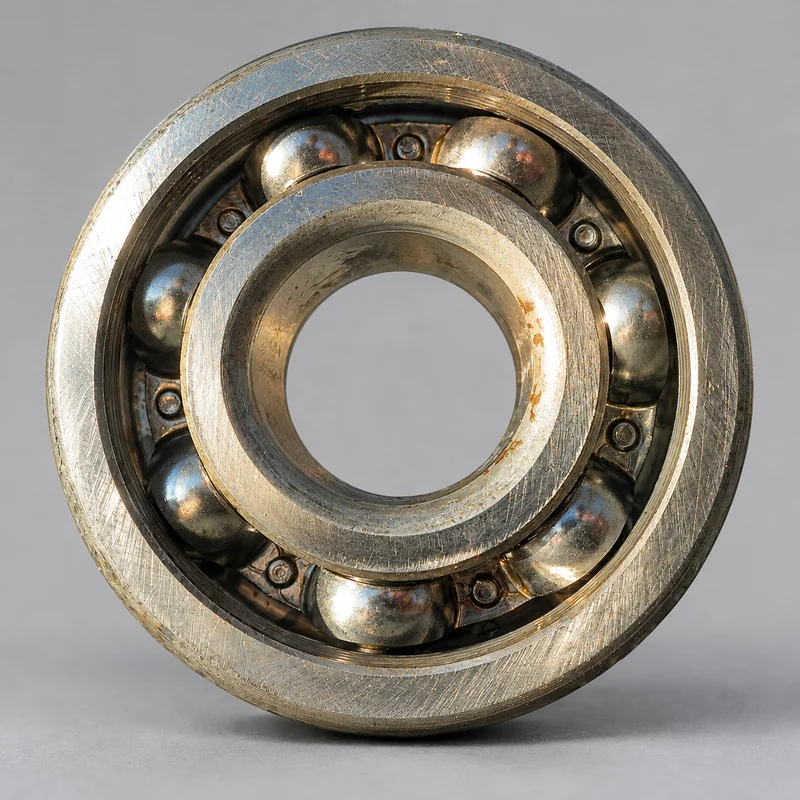
Deep groove ball bearing 6206
Deep groove ball bearing 6206, open, boundary dimensions 30 mm × 62 mm × 16 mm. Specifications below are model-bound published values; the source class is identified for each parameter. Send your application details through the RFQ for a confirmed quotation.
Last updated: 2026-11
Specifications
| Specification | Value | Parameter class | Source publisher |
|---|---|---|---|
| Bore diameter (d) | 30 mm | Model designation & boundary dimension | jtekt.co.jpManufacturer-published specification |
| Outside diameter (D) | 62 mm | Model designation & boundary dimension | jtekt.co.jpManufacturer-published specification |
| Width (B) | 16 mm | Model designation & boundary dimension | jtekt.co.jpManufacturer-published specification |
| Basic dynamic load rating (Cr) | 24.3 kN Basic dynamic load rating is a catalog reference used in bearing-life calculations; confirm equivalent load, speed, reliability and required service life for the application. | Manufacturer catalog reference — not a supply guarantee | jtekt.co.jpManufacturer-published specification |
| Basic static load rating (C0r) | 11.3 kN Basic static load rating is a catalog reference; verify equivalent static load and the required static safety factor for the application. | Manufacturer catalog reference — not a supply guarantee | jtekt.co.jpManufacturer-published specification |
| Limiting speed, grease lubrication | 11000 min-1 Catalog limiting speed for grease lubrication, not an application operating recommendation. Confirm lubricant, temperature, load, sealing and duty conditions before selection. | Manufacturer catalog reference — not a supply guarantee | jtekt.co.jpManufacturer-published specification |
| Limiting speed, oil lubrication | 13000 min-1 Catalog limiting speed for oil lubrication, not an application operating recommendation. Confirm lubricant, temperature, load, sealing and duty conditions before selection. | Manufacturer catalog reference — not a supply guarantee | jtekt.co.jpManufacturer-published specification |
| Shaft abutment diameter (da min.) | 35 mm | Model designation & boundary dimension | jtekt.co.jpManufacturer-published specification |
| Housing abutment diameter (Da max.) | 57 mm | Model designation & boundary dimension | jtekt.co.jpManufacturer-published specification |
| Fillet radius (r max.) | 1 mm | Model designation & boundary dimension | jtekt.co.jpManufacturer-published specification |
| Reference mass | 0.199 kg | Manufacturer catalog reference — not a supply guarantee | jtekt.co.jpManufacturer-published specification |
Parameter classes: Model designation & boundary dimension — what identifies the model (boundary dimensions follow the designation). Manufacturer catalog reference — the named manufacturer's published catalog data for this designation; it is not a guarantee that every unit we supply reaches these exact figures. Industry reference — a third-party or industry-published value; it is not specific to the named manufacturer and is not a supply guarantee. Supplier-confirmed — a value we have confirmed for our own supply. Order-confirmed — the value fixed in a specific order. None of the values on this page are supplier-confirmed yet; supply-specific figures (tolerance class, clearance, seal variant availability, lead time) are confirmed with your quotation.
The source publisher shown on each row identifies where that parameter was published; it is not necessarily the manufacturer supplying your order. Manufacturer-published specifications are linked where the source is approved for public linking. Industry-reference publishers are shown as text.
All values above are model-bound catalog values traceable to a collected source. Fields without collected evidence are not published; ask with your inquiry and we confirm them at quotation.
Manufacturer / model attribution: Koyo / JTEKT — 6206 (open). This is the manufacturer named by the model-evidence record; it does not establish that every item supplied for an inquiry comes from this manufacturer. The actual manufacturer, original model and supplying source are confirmed in the quotation.
Source per specification field
| Specification | Source |
|---|---|
| Bore diameter (d) | jtekt.co.jp — manufacturer-published specification |
| Outside diameter (D) | jtekt.co.jp — manufacturer-published specification |
| Width (B) | jtekt.co.jp — manufacturer-published specification |
| Basic dynamic load rating (Cr) | jtekt.co.jp — manufacturer-published specification |
| Basic static load rating (C0r) | jtekt.co.jp — manufacturer-published specification |
| Limiting speed, grease lubrication | jtekt.co.jp — manufacturer-published specification |
| Limiting speed, oil lubrication | jtekt.co.jp — manufacturer-published specification |
| Shaft abutment diameter (da min.) | jtekt.co.jp — manufacturer-published specification |
| Housing abutment diameter (Da max.) | jtekt.co.jp — manufacturer-published specification |
| Fillet radius (r max.) | jtekt.co.jp — manufacturer-published specification |
| Reference mass | jtekt.co.jp — manufacturer-published specification |
6206 vs 6205 vs 6207 vs 6204 — same-manufacturer series comparison
Nearest published designations in the same series. A manufacturer is named only when the evidence record identifies a bearing maker; otherwise the column says it is not identified. Source configuration and each field's publisher attribution remain separate. When more than one manufacturer appears, this is a cross-manufacturer catalog comparison, not an equivalence, interchangeability or common-source claim. Highlighted rows are the parameters that differ across these published records; unhighlighted rows have identical published values, not necessarily identical performance in service.
| Parameter | 6206 (this page) Manufacturer: Koyo / JTEKT Source configuration: open | 6205 Manufacturer: Koyo / JTEKT Source configuration: open | 6207 Manufacturer: Koyo / JTEKT Source configuration: open, boundary dimensions | 6204 Manufacturer: Koyo / JTEKT Source configuration: open |
|---|---|---|---|---|
| Bore diameter (d) | 30 mm standard-model · jtekt.co.jp · Manufacturer-published specification | 25 mm standard-model · jtekt.co.jp · Manufacturer-published specification | 35 mm standard-model · jtekt.co.jp · Manufacturer-published specification | 20 mm standard-model · koyo.jtekt.co.jp · Manufacturer-published specification |
| Outside diameter (D) | 62 mm standard-model · jtekt.co.jp · Manufacturer-published specification | 52 mm standard-model · jtekt.co.jp · Manufacturer-published specification | 72 mm standard-model · jtekt.co.jp · Manufacturer-published specification | 47 mm standard-model · koyo.jtekt.co.jp · Manufacturer-published specification |
| Width (B) | 16 mm standard-model · jtekt.co.jp · Manufacturer-published specification | 15 mm standard-model · jtekt.co.jp · Manufacturer-published specification | 17 mm standard-model · jtekt.co.jp · Manufacturer-published specification | 14 mm standard-model · koyo.jtekt.co.jp · Manufacturer-published specification |
| Basic dynamic load rating (Cr) | 24.3 kN reference-manufacturer · jtekt.co.jp · Manufacturer-published specification · Basic dynamic load rating is a catalog reference used in bearing-life calculations; confirm equivalent load, speed, reliability and required service life for the application. | 17.5 kN reference-manufacturer · jtekt.co.jp · Manufacturer-published specification · Basic dynamic load rating is a catalog reference used in bearing-life calculations; confirm equivalent load, speed, reliability and required service life for the application. | 32.1 kN reference-manufacturer · jtekt.co.jp · Manufacturer-published specification · Basic dynamic load rating is a catalog reference used in bearing-life calculations; confirm equivalent load, speed, reliability and required service life for the application. | 16 kN reference-manufacturer · koyo.jtekt.co.jp · Manufacturer-published specification · Basic dynamic load rating is a catalog reference used in bearing-life calculations; confirm equivalent load, speed, reliability and required service life for the application. |
| Basic static load rating (C0r) | 11.3 kN reference-manufacturer · jtekt.co.jp · Manufacturer-published specification · Basic static load rating is a catalog reference; verify equivalent static load and the required static safety factor for the application. | 7.85 kN reference-manufacturer · jtekt.co.jp · Manufacturer-published specification · Basic static load rating is a catalog reference; verify equivalent static load and the required static safety factor for the application. | 15.4 kN reference-manufacturer · jtekt.co.jp · Manufacturer-published specification · Basic static load rating is a catalog reference; verify equivalent static load and the required static safety factor for the application. | 6.65 kN reference-manufacturer · koyo.jtekt.co.jp · Manufacturer-published specification · Basic static load rating is a catalog reference; verify equivalent static load and the required static safety factor for the application. |
| Fatigue load limit (Cu) | — not published Not published for this designation | Not published for this designation | 1.1 kN reference-manufacturer · jtekt.co.jp · Manufacturer-published specification · Fatigue load limit is a catalog reference, not a standalone allowable-load or service-life guarantee; verify application duty and lubrication conditions. | 0.51 kN reference-manufacturer · koyo.jtekt.co.jp · Manufacturer-published specification · Fatigue load limit is a catalog reference, not a standalone allowable-load or service-life guarantee; verify application duty and lubrication conditions. |
| Limiting speed, grease | 11000 min-1 reference-manufacturer · jtekt.co.jp · Manufacturer-published specification · Catalog limiting speed for grease lubrication, not an application operating recommendation. Confirm lubricant, temperature, load, sealing and duty conditions before selection. | 13000 min-1 reference-manufacturer · jtekt.co.jp · Manufacturer-published specification · Catalog limiting speed for grease lubrication, not an application operating recommendation. Confirm lubricant, temperature, load, sealing and duty conditions before selection. | 9200 min-1 reference-manufacturer · jtekt.co.jp · Manufacturer-published specification · Catalog limiting speed for grease lubrication, not an application operating recommendation. Confirm lubricant, temperature, load, sealing and duty conditions before selection. | 15000 min-1 reference-manufacturer · koyo.jtekt.co.jp · Manufacturer-published specification · Catalog limiting speed for grease lubrication, not an application operating recommendation. Confirm lubricant, temperature, load, sealing and duty conditions before selection. |
| Limiting speed, oil | 13000 min-1 reference-manufacturer · jtekt.co.jp · Manufacturer-published specification · Catalog limiting speed for oil lubrication, not an application operating recommendation. Confirm lubricant, temperature, load, sealing and duty conditions before selection. | 15000 min-1 reference-manufacturer · jtekt.co.jp · Manufacturer-published specification · Catalog limiting speed for oil lubrication, not an application operating recommendation. Confirm lubricant, temperature, load, sealing and duty conditions before selection. | 11000 min-1 reference-manufacturer · jtekt.co.jp · Manufacturer-published specification · Catalog limiting speed for oil lubrication, not an application operating recommendation. Confirm lubricant, temperature, load, sealing and duty conditions before selection. | 17000 min-1 reference-manufacturer · koyo.jtekt.co.jp · Manufacturer-published specification · Catalog limiting speed for oil lubrication, not an application operating recommendation. Confirm lubricant, temperature, load, sealing and duty conditions before selection. |
Each published cell carries its own parameter tier and publisher attribution; each column identifies the manufacturer only when the evidence record names one, plus the source configuration. A source publisher is not necessarily the supplying source for an order. Cross-manufacturer values are shown for catalog context only: they do not establish interchangeability, equivalent quality, common manufacturing origin or a preferred supply route. Compare values only within the stated parameter class, publisher, configuration and operating conditions. Industry-reference values are not manufacturer-specific. Confirm fit, load, speed, clearance, sealing and actual supplying source for your application in the quotation.
SKF 6206 hybrid — open versus shielded WT-greased execution
SKF lists two materially different 6206 hybrid executions: the open 6206/HC5C3 and the shielded 6206-2ZTN9/HC5C3WT. Both use silicon-nitride rolling elements in bearing-steel rings and share the same 30 × 62 × 16 mm envelope and published basic load ratings, but the clearance, cage, closure, lubrication and limiting speed differ.
| Buyer check | 6206/HC5C3 | 6206-2ZTN9/HC5C3WT |
|---|---|---|
| Execution | Open hybrid | Hybrid with shields on both sides |
| Boundary dimensions (d × D × B) | 30 × 62 × 16 mm | 30 × 62 × 16 mm |
| Basic dynamic load rating C | 19.5 kN | 19.5 kN |
| Basic static load rating C₀ | 11.2 kN | 11.2 kN |
| Radial internal clearance | CN (Normal) | C3 (greater than Normal) |
| Cage | Sheet-metal cage | TN9 glass-fibre-reinforced PA66 cage |
| Lubrication | No lubricant listed | WT grease; no relubrication feature listed |
| Reference speed | 28,000 r/min | 28,000 r/min |
| Limiting speed | 18,000 r/min | 15,000 r/min |
| Reference mass | 0.173 kg | 0.173 kg |
Selection boundary: consider the shielded WT-greased execution when the bearing needs an integrated contamination barrier and factory-filled grease, while the hybrid ceramic rolling elements address electrical-current damage. Consider the open execution where the machine's lubrication arrangement is designed to supply the bearing externally. The shielded version's catalogue limiting speed is 15,000 r/min rather than 18,000 r/min; do not treat the shared 28,000 r/min reference speed as an allowable continuous operating speed.
Clearance is not interchangeable: the exact open 6206/HC5C3 product page lists CN, whereas the exact shielded 6206-2ZTN9/HC5C3WT page lists C3. C3 is a clearance class greater than Normal, not a single measured clearance. Do not assume every SKF hybrid 6206 is supplied with C3 merely because SKF's general hybrid catalogue describes C3 as the standard hybrid deep-groove clearance; use the complete designation and order documentation to confirm the selected execution.
SKF identifies WT as its wide-temperature grease; its hybrid designation guidance gives a grease temperature range of −40 to +160 °C. This is a grease property range, not a guaranteed operating-temperature rating for the complete bearing. SKF notes that the permissible bearing temperature can instead be limited by the rings, cage, seals or lubricant. The model page identifies shields, not contact seals, and does not publish a water-ingress rating.
Sources: SKF official 6206/HC5C3 product page; SKF official 6206-2ZTN9/HC5C3WT product page; SKF Rolling bearings, PUB BU/P1 17000/1 EN (October 2018), Chapter 21, printed pages 1045–1047 (hybrid bearing design, sealed-bearing lubrication, C3 reference, cage and temperature boundaries); SKF Electrically insulated bearings from SKF, hybrid suffix table, printed page 11 (HC5, TN9 and WT definitions and WT grease temperature range). Open SKF Rolling bearings catalogue. Open SKF electrically insulated bearings guide.
6206 electrical insulation — ceramic balls and ring coatings interrupt different current paths
Buyer conclusion: do not specify only “electrically insulated 6206” or accept a hybrid bearing and a ceramic-coated bearing as automatic equivalents. A hybrid bearing uses electrically insulating ceramic rolling elements between steel rings; a coated bearing places an insulating layer on a selected ring surface, isolating that ring from its shaft or housing seat. Both can reduce bearing-current damage, but the barrier is in a different place. The correct choice depends on the motor's current type, current path, converter frequency and which bearing position must be isolated.
| Architecture | Where the insulation sits | What the buyer must specify | What cannot be assumed |
|---|---|---|---|
| Hybrid ceramic rolling elements | Silicon-nitride balls or rollers interrupt the conductive rolling-contact path between the inner and outer rings; the rings remain bearing steel. | Exact hybrid designation, ceramic rolling-element material, bearing position, clearance, cage, seal/shield, lubricant and application-specific electrical evidence. | It is not a coated-ring product. Do not infer the same ring-to-seat insulation location or the same capacitance from the word “insulated”. |
| Ceramic-oxide-coated ring | An aluminium-oxide layer is applied to the outer ring's outside surface or the inner ring's bore/side faces. The selected ring is insulated from its mating housing or shaft interface. | Which ring is coated, coating code and thickness, DC withstand voltage, resistance, AC impedance/capacitance at the relevant frequency, and post-handling insulation inspection. | Outer-ring and inner-ring coating are not the same installation interface. A coating on the wrong ring or damaged coating may not interrupt the intended current path. |
The motor-current problem determines whether one bearing is enough
Schaeffler separates circular currents, discharge currents and rotor-ground currents. Its TPI 206 explains that circular currents can arise from shaft voltage and that a coated bearing is frequently used at the fan side; common-mode discharge currents can instead flow separately through both bearings in smaller inverter motors. For that case, Schaeffler describes two hybrid bearings and/or current-conductive solutions, or a coating selected at a suitable layer thickness. It explicitly says the motor and adjacent parts determine which solution is better. Therefore, a single insulated bearing is not a universal motor rule: the shaft-current path and the role of the drive-end and fan-end bearings must be established first.
High-frequency converter currents make a DC resistance number insufficient
Schaeffler's electrical model treats a current-insulated bearing as parallel resistance and capacitance. For DC and 50/60 Hz, ohmic resistance is decisive; for converter-related currents in the several-hundred-kHz to multi-MHz range, capacitive impedance becomes decisive. In TPI 206, a typical hybrid-bearing capacitance is stated as 40 pF, about 100 times lower than its ceramic-coated-bearing comparison. This is a Schaeffler typical-value comparison, not a universal value for every hybrid or coated SKU. A supplier's “1,000 V DC” result alone therefore does not establish equivalent protection at the motor's switching frequency.
6206 size availability creates a practical substitution boundary
The 6206 envelope is 30 × 62 × 16 mm. Published hybrid-ball options include SKF 6206-Z/HC5 and GMN HY 6206; NSK's 2023 ceramic-ball product table also lists 6206 at 30 × 62 × 16 mm. By contrast, the cited coated-bearing catalog ranges do not include this size: SKF states outer-ring INSOCOAT for outside diameters above 80 mm and inner-ring coating for bore diameters above 70 mm; Schaeffler's J20G table lists outer-ring coatings for outside diameters 70–800 mm and inner-ring J20GI for bores of at least 70 mm; NSK's HDY2 range lists 60–130 mm bore diameters. A 6206 has D = 62 mm and d = 30 mm, so it falls outside those published coated ranges. This is a boundary of the cited catalogued ranges, not proof that a manufacturer cannot offer a special coated design by agreement.
Even two hybrid 6206 products are not rating-equivalent by designation alone
| Published execution | d × D × B | Cr | C0r | Speed field and condition | Other execution data |
|---|---|---|---|---|---|
| GMN 6206, steel balls | 30 × 62 × 16 mm | 20.0 kN | 11.8 kN | Oil limit 21,600 rpm; GMN states the speed applies to an individual bearing with spring preload | P4; T9H cage; 2Z on request |
| GMN HY 6206, ceramic balls | 30 × 62 × 16 mm | 20.0 kN | 8.3 kN | Oil limit 27,000 rpm; same individual-bearing spring-preload condition | P4; T9H cage; 2Z on request |
Within GMN's own same-size comparison, the published dynamic rating stays at 20.0 kN, while the static rating changes from 11.8 to 8.3 kN (about 29.7% lower, calculated from the two published values); the oil speed limit rises from 21,600 to 27,000 rpm (25% higher, calculated). This is a useful warning for replacement screening: equal dimensions and equal Cr do not preserve C0r. The speed values are still not an application speed guarantee; GMN requires individual-bearing spring preload and correction factors for deviations from its stated conditions.
SKF's separate 6206-Z/HC5 product is also 30 × 62 × 16 mm, with C = 19.5 kN, C0 = 11.2 kN, CN clearance, one non-contact shield, no lubricant listed, reference speed 28,000 r/min and limiting speed 18,000 r/min. Do not rank its 28,000 reference speed against GMN's 27,000 oil limiting speed: these are different speed fields, and the exact executions differ in closure, lubrication and other design details.
RFQ and acceptance requirements
- Describe the motor type, converter topology/switching-frequency range, voltage/current symptoms, grounding and shaft-grounding arrangement, and whether the observed current is circular, discharge or rotor-ground current.
- Identify drive-end and fan-end bearing positions and ask the motor/bearing engineer to mark the intended current path and the ring/seat interface that must be insulated.
- For a coated option, state inner or outer ring, coating code, thickness, DC withstand voltage, resistance and AC impedance/capacitance at the relevant frequency; request the manufacturer's insulation test record and coating-handling instructions.
- For a hybrid option, state ceramic rolling-element material and exact suffix; confirm clearance, cage, shield/seal, grease, Cr, C0r and the applicable speed basis.
- For either option, confirm fit, shaft/housing material, mounting method, preload, operating temperature, actual load spectrum and the required insulation verification after installation.
Scope and limits: this section compares published architectures and catalogued 6206 examples; it does not diagnose a particular motor's current path or approve a bearing arrangement. Schaeffler's 40 pF and 100× comparison are its stated typical values, not universal material constants. The SKF, Schaeffler and NSK coating size limits are only the cited published ranges; special designs may be available by agreement. GMN's C0r and speed comparison is manufacturer-specific and does not prove that every hybrid 6206 has lower static capacity. No common-frequency, common-voltage, common-humidity insulation test across these manufacturers was found.
Sources: SKF, Rolling bearings and seals in electric motors and generators, PUB 54/P7 13459 EN, August 2013, “INSOCOAT bearings”, printed pp. 26–27 (coating location, size limits, 1,000 V DC / 50 MΩ and insulation testing) and “Hybrid bearings”, pp. 28–29 (Si3N4 rolling elements and high-frequency converter use); SKF electric-motor bearing handbook. Schaeffler, Current-Insulated Bearings, TPI 206 / 03 / en-GB / DE / 2024-05, §2.1 printed p. 5 (current types and bearing positions), §3.1.2 pp. 9–10 (resistance/capacitance and frequency dependence), §3.2.4 Table e1 p. 17 (J20G coating data and size ranges), §3.3 pp. 20–21 (hybrid comparison) and §3.4 p. 22 (application-dependent recommendations); Schaeffler TPI 206 PDF. NSK, Industrial Motor Bearings, CAT. No. E1289c 2023 Z-7, “Ceramic-Coated Insulated Bearings for Inverter Motors”, printed pp. 12–13, and “Ceramic Ball Bearings”, pp. 18–19 (HDY2 size range, 6311 test conditions, ceramic-ball principle and 6206 size listing); NSK E1289c catalogue. GMN official 6206 and HY 6206 product records (30 × 62 × 16 mm, P4, T9H, Cr/C0r, oil speed and spring-preload condition); GMN 6206 / GMN HY 6206. SKF official 6206-Z/HC5 product record.
JTEKT 6206 2RD vs 2RS — seal contact, grease speed and operating boundaries
JTEKT publishes both 6206 2RD and 6206 2RS as double-sided sealed, single-row deep-groove ball bearings with the same 30 × 62 × 16 mm envelope and the same catalog load ratings. The meaningful distinction is the seal execution: 2RD is an extremely light-contact seal, while 2RS is a contact seal.
| Buyer check | JTEKT 6206 2RD | JTEKT 6206 2RS |
|---|---|---|
| Seal execution | Double, extremely light-contact sealed | Double, contact sealed |
| Boundary dimensions (d × D × B) | 30 × 62 × 16 mm | 30 × 62 × 16 mm |
| Basic dynamic load rating Cr | 24.3 kN | 24.3 kN |
| Basic static load rating C0r | 11.3 kN | 11.3 kN |
| Fatigue load limit Cu / factor f0 | 0.800 kN / 13.9 | 0.800 kN / 13.9 |
| Catalog limiting speed, grease lubrication | 9,900 min⁻¹ | 7,000 min⁻¹ |
| Catalog seal behavior | Small friction torque; good high-speed performance | Large friction torque; high-speed performance limited by seal contact |
| Grease sealing / dirt resistance | Excellent / excellent | Excellent / excellent |
| Water-resistance description in JTEKT comparison | Better than ZZ and 2RU | Better than 2RU for low-speed applications |
| Standard-type operating temperature | −30 to +110°C | −30 to +100°C |
| Mounting dimensions | da 35–37.5 mm; Da max. 57 mm; ra max. 1 mm | |
| Reference mass shown on product page | 0.199 kg | 0.199 kg |
Selection reading: 2RD is the stronger candidate when lower seal friction and a higher catalog grease-speed limit matter; 2RS is the contact-seal alternative when its published contact-seal behavior is preferred. Both are sealed executions, and JTEKT rates grease sealing and dirt resistance as excellent for both. The catalog does not describe 2RD as non-contact.
Conditions and ordering boundary: the speed values are manufacturer catalog limiting speeds for grease lubrication, not guaranteed continuous operating speeds. The temperature ranges are for standard seal and grease types; JTEKT notes that a wider range may be possible with different grease or sealing material, subject to consultation. The cited product pages do not identify the grease formulation or fill quantity. JTEKT also warns that catalog tables may include products no longer in production, so current production and stock status must be confirmed for the exact designation before quotation.
Sources: JTEKT / Koyo Ball & Roller Bearings catalogue (Table 1, printed page B6: seal type, friction torque, high-speed behavior, grease sealing, dirt/water resistance and standard temperature; specification table, printed pages B22–B23, 30 × 62 × 16 mm row: 6206 2RD / 6206 2RS, ratings, grease speeds and mounting dimensions); 6206 2RD product page (exact extremely-light-contact execution and product specifications); 6206 2RS product page (exact contact-sealed execution and product specifications).
6206 across manufacturers — Cr, C0r and the limit of life comparison
Buyer conclusion: the same 30 × 62 × 16 mm envelope does not guarantee the same published load ratings. In the five manufacturer records compared here, basic dynamic rating Cr ranges from 20.3 to 24.3 kN (about 19.7% spread), while basic static rating C0r ranges only from 11.2 to 11.3 kN (about 0.9% spread). Dynamic-fatigue screening and static-peak-load verification must therefore be done separately. The highest Cr is not, by itself, proof of longer real service life or a drop-in replacement.
| Manufacturer / exact designation | d × D × B | Cr | C0r | Published execution detail |
|---|---|---|---|---|
| JTEKT / Koyo 6206 | 30 × 62 × 16 mm | 24.3 kN | 11.3 kN | Single-row deep-groove, open; product page does not state clearance or tolerance class |
| NSK 6206 | 30 × 62 × 16 mm | 21.4 kN | 11.3 kN | Open, pressed-steel cage, P0; 9 balls, 9.525 mm diameter |
| SKF 6206 | 30 × 62 × 16 mm | 20.3 kN | 11.2 kN | Open, SKF Explorer, CN |
| NTN AC-6206 | 30 × 62 × 16 mm | 21.6 kN | 11.3 kN | NTN AC-series catalogue designation; retain the AC prefix |
| Schaeffler / FAG 6206-C>V | 30 × 62 × 16 mm | 22.0 kN | 11.3 kN | Generation C, open, P6, CN, SN dimensional stabilization to 120°C |
What the pattern means: the published Cr spread is materially larger than the C0r spread. Do not convert a higher Cr into a higher static overload allowance. For a rotating fatigue duty, use the exact bearing's equivalent dynamic load P and rating-life method. For a stationary or peak-load case, calculate the static equivalent load P0 and required static safety factor against C0r separately.
Conditional life calculation — not a test result: for a radial ball bearing, the basic ISO 281 life equation is L10 = (C / P)3 in millions of revolutions. If two ratings are calculated on the same standard basis and are compared at the same equivalent load P, same speed and 90% reliability, the ratio of the theoretical basic lives at Cr = 24.3 and 20.3 kN is (24.3 / 20.3)3 ≈ 1.72. This is an arithmetic screening result only. It is not measured service life, does not establish that one bearing lasts 1.72 times longer in a real machine, and must not be used as a warranty or acceptance guarantee. Where axial load is present, P = XFr + YFa must be taken from the relevant maker's product data; with variable load, the duty cycle must also be reduced appropriately.
Why a direct brand ranking remains open: JTEKT's public Calculation of service life page (§5-2-1) still says basic dynamic ratings are prescribed by ISO 281:1990 and may change with later ISO standards. ISO lists ISO 281:1990 as withdrawn and ISO 281:2007 as the current published edition. JTEKT's live 6206 product page does not state which edition underlies its 24.3 kN. NTN's 2024 catalogue says it reflects the latest ISO/JIS revisions and that its basic dynamic ratings were revised using accumulated in-house durability-test data. SKF's 2018 catalogue says Explorer ratings are adjusted under ISO 281 and verified by endurance testing. These are important manufacturer disclosures, but they do not provide a common five-brand test protocol or reveal all internal geometry and material differences. The rating gap is real in the published data; its exact design cause and fully normalized life impact remain unverified.
Procurement and acceptance checks: request the complete manufacturer designation and product generation (do not omit AC-6206 or 6206-C>V); confirm whether the required execution is open, shielded or sealed; obtain Cr, C0r and Cu with the applicable ISO/JIS edition and current datasheet revision; obtain the maker's X/Y factors for the actual Fr/Fa combination; calculate P0 and the static safety factor for maximum stationary/impact loads; and confirm clearance, precision class, cage, heat stabilization, grease, fit, temperature and duty cycle before approving a substitute. If a supplier claims a life advantage, ask for the exact calculation basis and relevant endurance-test or qualification evidence.
Sources: JTEKT / Koyo, 6206 official product record (30 × 62 × 16 mm, Cr 24.3 kN, C0r 11.3 kN; accessed 2026-11-25), and Calculation of service life (§§5-2-1–5-2-2; ISO 281:1990 statement; accessed 2026-11-25); NSK, 6206 official product record (Cr 21.4 kN, C0r 11.3 kN, P0/open execution; accessed 2026-11-25); SKF, 6206 official product record (Cr 20.3 kN, C0r 11.2 kN, Explorer/CN/open; accessed 2026-11-25), and Rolling bearings, PUB BU/P1 17000/1 EN, October 2018 (§B.3 pp.88–91: L10 equation, p = 3 for ball bearings, Explorer rating method); NTN, Ball and Roller Bearings, CAT. No. 2203-3/E, ©2024 (front-matter rating revision note; AC Bearings, printed pp.B-40–B-41, AC-6206 row: Cr 21.6 kN, C0r 11.3 kN); Schaeffler / FAG, 6206-C>V Generation C product data sheet (generated 2025-09-29, p.1: Cr 22.0 kN, C0r 11.3 kN, P6/CN/SN); ISO, ISO 281:2007 (Edition 2, 2007-02; current published edition status) and ISO 76:2006 (Edition 3, 2006-05; static load-rating scope and limitations).
6206 P5 vs P6 — precision class changes runout acceptance, not the bearing envelope
Buyer conclusion: “6206” identifies the nominal bearing size and type, not a guaranteed precision class. The exact NSK 6206P5 product is published as ISO Class 5; SKF's standard 6206 product is published as ISO Class 6 (P6). These are different tolerance executions even though both are 30 × 62 × 16 mm open deep-groove bearings. If the machine requires a Class 5 running-accuracy limit, a Class 6 quotation is not an automatic substitute. State the required class and the specific runout characteristic in the RFQ rather than asking for “6206 precision” or accepting an unqualified “ABEC equivalent”.
| Source / exact product | Published precision | Published assembled-ring runout | Other published identity |
|---|---|---|---|
| NSK 6206P5 | P5 / ISO Class 5 | NSK CAT. No. E1103, Table 7.2.1, d over 18 up to 30 mm: Kia Class 5 maximum 4 μm; Class 6 maximum 8 μm | 30 × 62 × 16 mm; open; CN; pressed-steel cage |
| SKF 6206 | ISO Class 6 (P6) | Product record: tKia 8 μm; tKea 13 μm | 30 × 62 × 16 mm; open; Explorer; CN |
What is actually being compared: NSK defines Kia as radial runout of the assembled bearing inner ring and Kea as radial runout of the assembled outer ring. The NSK table gives 4 μm for Class 5 and 8 μm for Class 6 at the 30 mm bore boundary. SKF's exact 6206 record reports 8 μm for its inner-ring assembled runout (tKia) and 13 μm for its outer-ring assembled runout (tKea). The 8 μm inner-ring figure is consistent with the Class 6 value in NSK's table; it is not evidence that SKF's Class 6 product is a Class 5 equivalent. Do not compare Kia with Kea: they describe different rings and rotating arrangements.
Cross-reference caution: NSK's E1103 Table 7.1 maps deep-groove ball bearing Class 5 to ISO 492 Class 5 and lists ABEC 5 as the corresponding ANSI/ABMA Std. 20 reference; Class 6 maps to ABEC 3. This is a tolerance-class correspondence, not a blanket interchange approval. It does not establish equal internal clearance, noise, vibration, torque, load rating, lubrication, or batch measurement results. Require the exact standard and acceptance characteristic; do not infer them from an isolated “ABEC 5” label.
Edition boundary that must remain open: ISO now lists ISO 492:2023, Edition 6 (published August 2023), as the published edition; it says the revision changed parts of the geometrical-product-specification system and aligned/revised tolerance tables. SKF's general tolerance guidance still explicitly cites ISO 492:2014, while NSK's E1103 tolerance tables identify ISO 492 but do not state the edition in the cited table. The public 6206 product records do not identify the edition behind every displayed tolerance value. Therefore the catalogue figures above are useful screening evidence, but they do not settle which edition governs a current purchase order. Ask each supplier to confirm the applicable ISO 492 edition and the order's inspection method in writing; do not silently replace a maker's published table with a newer table or vice versa.
RFQ and receiving acceptance
- Specify the complete original manufacturer designation and required tolerance class: ISO Class 5 / P5 or ISO Class 6 / P6.
- State which ring rotates in service and whether the acceptance limit is inner-ring radial runout (Kia) or outer-ring radial runout (Kea).
- State the governing ISO 492 edition and require the supplier to identify any maker-specific or legacy inspection basis.
- Request the applicable dimensional and running-accuracy limits separately; do not treat bore/OD fit measurements as proof of assembled-ring runout.
- For precision-critical service, request a lot-specific measurement report identifying the measured characteristic, setup, instrument, measured values and acceptance limits.
- Keep clearance class (CN/C3), cage, seals, load ratings and lubrication as separate purchasing fields; P5 does not imply a particular value for any of them.
Scope and limits: this is a precision-class and published runout comparison for the exact NSK 6206P5 and SKF 6206 records, supported by manufacturer tolerance tables. The NSK Class 5 / Class 6 values are from CAT. No. E1103, Table 7.2.1; the current ISO 492:2023 edition boundary is noted because the NSK table does not identify its edition and SKF's general guidance cites ISO 492:2014. No lot-specific measurement certificates, common measurement trial, noise/vibration test, or machine-specific runout requirement was supplied. This does not rank manufacturers, establish a universal P5-to-P6 replacement rule, or guarantee machine vibration or spindle performance.
Sources: NSK, official 6206P5 product record (30 × 62 × 16 mm, open, CN, tolerance ISO Class 5; accessed 2026-11-25); NSK, Rolling Bearings for Industrial Machinery, CAT. No. E1103, §7.1 Table 7.1, printed p. A126 (deep-groove class correspondence and ABEC reference), and Table 7.2.1, printed pp. A128–A129 (Kia Class 5 / Class 6 values for 18–30 mm bore range); NSK E1103 catalogue PDF. SKF, official 6206 product record (30 × 62 × 16 mm, ISO Class 6, tKia 8 μm and tKea 13 μm; accessed 2026-11-25), and SKF Tolerances (Class 5 tighter than Class 6; stated reference to ISO 492:2014 and ANSI/ABMA Std. 19.2; accessed 2026-11-25). ISO, ISO 492:2023, Edition 6, published 2023-08, scope and revision history (current published edition and revised GPS/tolerance-table framework).
Applications and selection notes
Deep groove ball bearings are the default radial bearing for electric motors, fans, pumps, gearboxes, agricultural machinery and general industrial equipment. The single-row design carries radial load and a limited axial load in both directions, needs no adjustment after mounting, and runs at higher speeds than most alternative types of the same size.
In the sealed (2RS) and shielded (ZZ) executions, the bearing is lubricated for life and maintenance-free under normal operating conditions, which is why motor and appliance manufacturers standardise on them. In the open execution, the bearing is lubricated from the housing or shaft — the usual choice when the surrounding assembly provides filtration, re-lubrication or oil-bath lubrication.
How to read the specification table
Read the specification table against three limits. Boundary dimensions (bore, outside diameter, width) decide whether the bearing fits the shaft and housing — these are standardised designation-bound values and interchangeable across conforming manufacturers. Load ratings (Cr, C0r) describe different failure checks: Cr is used for rolling-fatigue life under dynamic load; C0r is the ISO 76 basic static rating tied to a defined contact-stress / permanent-deformation criterion, not a universal allowable working load.
Do not approve a bearing from C0r alone. For a deep-groove ball bearing, first convert the actual radial/axial load combination to the equivalent static load P0 using the exact maker’s X0/Y0 factors, then calculate s0 = C0r / P0. The required s0 is an application criterion, not a suffix or a universal constant: NTN’s Precision Rolling Bearings catalogue (Table 3.3) gives minimum values for ball bearings of 2 for quiet-rotation applications, 1.5 for impact-load applications and 1 for normal-rotation applications, and explicitly says vibration/shock requires a shock-load factor in P0 max. SKF’s 2018 general catalogue separately classifies rotating versus non-rotating duty, quiet-running requirement and shock severity in Table 5, and says to use the maximum load that can occur. These tables are not a common test or a directly transferable brand ranking; their application categories differ. For ordinary aligned arrangements, use the exact maker’s C0r, X0/Y0 and stated duty assumptions. Where shaft/housing tilt, misalignment, moment load or operating clearance materially changes rolling-element load sharing, the simplified ISO 76 C0/P0 check may miss the peak-loaded element: ask for an effective static safety-factor calculation using ISO 17956:2025 or an equivalent documented internal-load-distribution method. ISO 17956 adds tilt/misalignment, operating clearance and internal load distribution; it checks static deformation only, not fatigue life, false brinelling, wear or microspalling. In the RFQ, provide peak radial and axial loads, shock duration/direction, rotation state, required quietness, operating clearance, shaft/housing misalignment and moment load; request the maker’s P0 factors, selected s0 basis and calculation assumptions. Do not use Cr as a substitute for this static check or treat a passing basic C0/P0 ratio as proof for a tilted or moment-loaded assembly.
Limiting speeds are catalog values established for the manufacturer’s execution, clearance and lubrication; they are not an operating recommendation for your application. Sealed and shielded executions, heavy fits, elevated temperature or misalignment all reduce the usable speed. Confirm the speed and clearance choice against your actual conditions before ordering — the internal-clearance class in particular should follow fit, temperature and speed, not a default.
Cross reference: see how 6206 relates to its ZZ / 2RS executions and the rest of its series — boundary dimensions first, execution and clearance confirmed per application on the bearing cross reference page.
Related engineering knowledge
Background reading that supports the selection decision on this page — failure modes, seal trade-offs and lubrication behavior. These articles explain the engineering; the specifications and supply commitments live on this page and in the quotation.
6206 — buying questions
What does the designation 6206 mean?
6206 is a standard boundary-dimension designation: the dimension series fixes the outside diameter and width proportions, and the bore code fixes the bore diameter — 30 mm for this bearing. Two bearings carrying the same designation from conforming manufacturers are dimensionally interchangeable; execution (seals, clearance class, cage) is the part that can differ, so state the execution you need when you request a quotation.
Are the catalog load rating and speed of 6206 enough for my application?
The table lists Basic dynamic load rating (Cr) = 24.3 kN and grease-lubricated limit 11000 min-1 and oil-lubricated limit 13000 min-1. The load rating is the starting point of a life calculation, and each speed is a catalog limit for the manufacturer’s execution, not an application operating recommendation. Seals, fits, temperature and lubrication all affect the usable speed in a real assembly. Both lubricant-specific limits are listed; compare each only under its stated lubricant and manufacturer execution. Send the application conditions with your inquiry and we confirm suitability before quoting; do not size from the catalog speed alone.
What information do you need to quote 6206?
Four things, in one message: the designation (and execution — seals, clearance class, precision class, if not standard), the quantity, the destination country, and any documents you require. Application conditions such as speed, load direction and temperature are welcome and let us verify the execution instead of assuming it. Quotation, lead time and the exact document set come back in writing.
Ordering & documentation
Documents
The documents available for 6206 depend on the actual supplying source and order. State any required export, origin, material or inspection documents in your inquiry; the available document set is confirmed in writing with the quotation.
Quotation
To quote 6206, send: the designation and required execution, quantity, destination country, and any required documents. Adding the application conditions (speed, load direction, temperature, fit) lets us confirm the execution and clearance class instead of quoting blind.
Sample & supply
If you need an evaluation sample of 6206, state the required quantity and timing. Sample feasibility, source, price and dispatch timing are confirmed in the quotation; sample availability is not assumed from the standard designation alone.
Lead time for this designation and quantity is confirmed in the quotation against the actual supplying source and availability. Any applicable certificates and quality documents are confirmed for the actual supplying source and product; available documents are stated in the quotation.
Storage & shipping
Store bearings flat in their original, unopened packaging in a dry indoor area away from temperature swings. Confirm the actual preservation method, packaging, marking and transport protection for the supplying source and order before shipment. Do not rotate a bearing through its rolling elements during handling or mounting.