
Cross reference · 7300 series · angular contact
7300 Series Angular Contact Ball Bearing Cross Reference
The 7300 series is the medium single-row line of the angular contact dimension plan: the same bores as the light 7200 series in a wider, taller ring, for spindles and arrangements where axial loads, reversing loads or rigidity rule out a deep groove bearing. Each row below is one base designation with its published boundary dimensions and load rating, plus the 7200-series bearings that share the same bore. Every value is the same model-bound catalog figure as on the linked page — this table adds none. Executions we have not published with evidence are marked for confirmation at quotation, not guessed.
Last updated: 2026-11
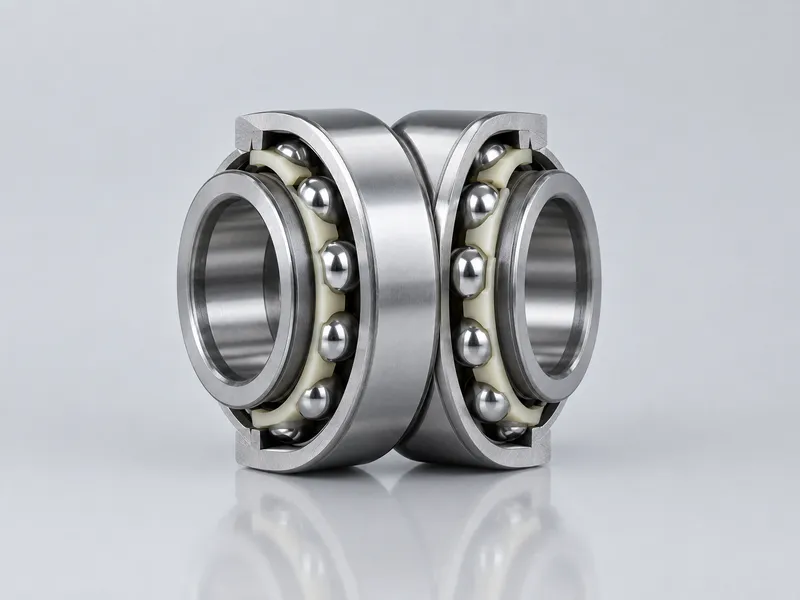
7300 series executions — open B, paired, sealed
7303B is the open execution with the B contact angle, as marked in our collected manufacturer catalog; it carries one-directional axial capacity and is usually installed in pairs (DB back-to-back, DF face-to-face or DT tandem) where loads act both ways. Our published evidence for the 7300 series currently covers the open B execution only, so the paired and sealed cells below are shown as Confirm at quotation: we supply those executions on request after confirming the details, we do not quote them from this table. The base designations 7303B through 7320B are all present in our collected manufacturer catalog and all published below; smaller and larger bores of the series (7300–7302, 7321B and up) are not published yet — send them to us and we confirm availability at quotation.
| Base designation | Bore d (mm) | OD D (mm) | Width B (mm) | Cr (open) | Open (B) | Paired (DB/DF/DT) | Sealed / shielded | RFQ |
|---|---|---|---|---|---|---|---|---|
| 7303B | 17 | 47 | 14 | 18.5 kN | 7303B | Confirm at quotation | Confirm at quotation | Request quote |
| 7304B | 20 | 52 | 15 | 21.7 kN | 7304B | Confirm at quotation | Confirm at quotation | Request quote |
| 7305B | 25 | 62 | 17 | 30.5 kN | 7305B | Confirm at quotation | Confirm at quotation | Request quote |
| 7306B | 30 | 72 | 19 | 36.6 kN | 7306B | Confirm at quotation | Confirm at quotation | Request quote |
| 7307B | 35 | 80 | 21 | 45.8 kN | 7307B | Confirm at quotation | Confirm at quotation | Request quote |
| 7308B | 40 | 90 | 23 | 56 kN | 7308B | Confirm at quotation | Confirm at quotation | Request quote |
| 7309B | 45 | 100 | 25 | 67 kN | 7309B | Confirm at quotation | Confirm at quotation | Request quote |
| 7310B | 50 | 110 | 27 | 85.3 kN | 7310B | Confirm at quotation | Confirm at quotation | Request quote |
| 7311B | 55 | 120 | 29 | 98.4 kN | 7311B | Confirm at quotation | Confirm at quotation | Request quote |
| 7312B | 60 | 130 | 31 | 113 kN | 7312B | Confirm at quotation | Confirm at quotation | Request quote |
| 7313B | 65 | 140 | 33 | 127 kN | 7313B | Confirm at quotation | Confirm at quotation | Request quote |
| 7314B | 70 | 150 | 35 | 143 kN | 7314B | Confirm at quotation | Confirm at quotation | Request quote |
| 7315B | 75 | 160 | 37 | 156 kN | 7315B | Confirm at quotation | Confirm at quotation | Request quote |
| 7316B | 80 | 170 | 39 | 169 kN | 7316B | Confirm at quotation | Confirm at quotation | Request quote |
| 7317B | 85 | 180 | 41 | 182 kN | 7317B | Confirm at quotation | Confirm at quotation | Request quote |
| 7318B | 90 | 190 | 43 | 195 kN | 7318B | Confirm at quotation | Confirm at quotation | Request quote |
| 7319B | 95 | 200 | 45 | 209 kN | 7319B | Confirm at quotation | Confirm at quotation | Request quote |
| 7320B | 100 | 215 | 47 | 238 kN | 7320B | Confirm at quotation | Confirm at quotation | Request quote |
Same-bore companions in the 7200 series
The light 7200 series and the medium 7300 series share their bore numbers: for each 73xx designation, the 72xx companions below are published pages whose bore dimension was checked equal — a 72xx companion fits the same shaft in a narrower and shallower ring with a lower load rating, trading capacity for space. Same bore is still only the first check: contact angle, clearance class, cage design and speed capability can differ between series and brands, so confirm the substitution against your application or send us the original designation. Deep-groove bearings sharing these bores are listed on the deep groove cross reference pages, not here — a contact bearing and a deep groove bearing are not exchange pairs even at equal boundary dimensions.
| 7300-series designation | Bore d (mm) | Published same-bore 72xx companions | Companion boundary (d × D × B, mm) |
|---|---|---|---|
| 7304B | 20 | 7204B | 7204B: 20 × 47 × 14 |
| 7305B | 25 | 7205B | 7205B: 25 × 52 × 15 |
| 7306B | 30 | 7206B | 7206B: 30 × 62 × 16 |
| 7307B | 35 | 7207B | 7207B: 35 × 72 × 17 |
| 7308B | 40 | 7208B | 7208B: 40 × 80 × 18 |
| 7309B | 45 | 7209B | 7209B: 45 × 85 × 19 |
| 7310B | 50 | 7210B | 7210B: 50 × 90 × 20 |
| 7311B | 55 | 7211B | 7211B: 55 × 100 × 21 |
| 7312B | 60 | 7212B | 7212B: 60 × 110 × 22 |
| 7313B | 65 | 7213B | 7213B: 65 × 120 × 23 |
| 7314B | 70 | 7214B | 7214B: 70 × 125 × 24 |
| 7315B | 75 | 7215B | 7215B: 75 × 130 × 25 |
| 7316B | 80 | 7216B | 7216B: 80 × 140 × 26 |
| 7317B | 85 | 7217B | 7217B: 85 × 150 × 28 |
| 7318B | 90 | 7218B | 7218B: 90 × 160 × 30 |
| 7319B | 95 | 7219B | 7219B: 95 × 170 × 32 |
| 7320B | 100 | 7220B | 7220B: 100 × 180 × 34 |
Where the 7300 series fits
Angular contact ball bearings carry combined loads: the contact angle between the raceway and the ball axis lets the ring support a substantial axial component in one direction, which a same-bore deep groove bearing accepts only in limited measure. The B suffix on every designation above marks the contact angle class of our collected catalog's execution. What the designation does not settle: internal clearance, preload, cage material and matched-pair grinding can all differ between brands and executions — so treat an equivalent as a candidate, not a confirmed swap. The checking sequence is described in how to find a replacement for an existing bearing model.
This page covers the 7300 (medium) series only. The light 7200 series is on its own 7200 series cross reference page, and the deep groove series (60xx/62xx/63xx/68xx/69xx) on the main deep groove ball bearing cross reference hub.
Failure modes in service — 7300 series
The 7300 series takes the angular contact plan one section taller than the 7200: more load capacity and more tilt stiffness in the same bores, at lower limiting speeds. That extra section changes the failure-mode weighting — heavier loads make fits, creep and preload management decisive, while the shared angular contact constants (one-directional thrust, pairing, cage at speed) remain. These are the documented early-death modes for 73xx positions.
Preload and thermal growth under heavier load
The heavier the duty on a 73xx pair, the more heat it makes — and preload design becomes a thermal problem, not just a stiffness setting. The documented balance: insufficient preload leads to skidding, fretting corrosion and premature fatigue, while excessive preload generates unnecessary heat, friction losses and accelerated wear — a narrow window that tightens further under dynamic loading, with temperature-driven differential expansion as the critical constraint (preload design analysis). High-speed systems add rapid acceleration, combined loads and thermal expansion effects, where improper load matching surfaces as skidding, vibration and reduced fatigue life (high-speed machinery bearing guide).
For a 73xx position this reads as a process requirement: the preload/clearance setting is chosen against the operating temperature, verified hot — a pair set correctly cold can run preloaded hot. State the duty cycle and thermal environment in the inquiry; the clearance execution is confirmed at quotation.
Arrangement errors: DB, DF, DT and the wrong one
Every 73xx carries the family constants — axial load in one direction only, bidirectional thrust requiring back-to-back or face-to-face pairs (angular contact selection guide) — but the medium section raises the cost of choosing the wrong arrangement. The matched-set options are specific: back-to-back (DB) for the highest moment rigidity under overturning moments, face-to-face (DF) to accommodate thermal expansion at lower moment rigidity, tandem (DT) for maximum one-direction capacity (matched-set arrangements; pairing arrangements guide). A DB set specified where the shaft grows axially — long hot shafts, belt-driven spindles — preloads itself thermally and fails exactly like an over-preloaded pair.
The mounting error class completes the set: pairing non-matched bearings against each other imposes unknown preload, which is why factory-matched sets exist for positions that need a defined value. We supply 73xx designations singly and confirm pair/duplex execution at quotation — the published pages here are open single executions, and the table does not assume a pair.
Fits, creep and fretting under real load
A medium-section angular contact bearing is usually the loaded ring of its arrangement, which puts the fit rules to work: the ring that rotates relative to the load direction needs an interference fit, and a rotating ring under load with a loose fit will creep — wearing the seat, generating heat and fretting debris, and progressively loosening further until "the shaft seat is destroyed along with the bearing" (bearing fits and tolerances documentation). The stationary ring takes the slight clearance fit that allows thermal movement — reversing that logic is a classic 73xx installation failure.
Interference has its own bill on this series: a tight fit expands the inner ring into the clearance and a tight housing fit compresses the outer ring, and the combination can drive internal clearance negative — "effectively rendering the shaft bigger than the hole" — with excessive friction and early failure (bearing fits and damage documentation). The clearance class for a 73xx pair is therefore chosen after the fits, against the operating temperature; abutment dimensions on the linked pages are the inputs.
False brinelling in standby and transit
Heavy positions stand still under real load, and that is precisely the false brinelling recipe: cyclic vibration breaks the lubricant film of a stationary, loaded bearing; corrosion and wear form shallow depressions at rolling-element pitch — dull, discoloured, sometimes reddish (SKF bearing-damage documentation). Standby pumps run as installed spares, coupled spares vibrated by the running machine next to them, and equipment in transport all produce it; the teardown signature is unambiguous — "brinelling suggests impact or false brinelling from vibration at standstill" (motor bearing damage-pattern guide).
Countermeasures live in the installation plan: turn standby sets over periodically, unload the bearings of stored machines, and inspect at pitch spacing after transport. A 73xx found with pitch-spaced damage at commissioning is replaced, not run in — the dents are true stress concentrations and will spall early.
Cage and lubrication at the speed ceiling
The 7300 series trades limiting speed for capacity, and its cage sits closer to the inertial-load regime as a result: equipment that rapidly changes RPM subjects the cage to high inertial loads, which can fatigue it to functional end-of-life even without a raceway spall — the documented fix being a more robust cage design (bearing speed-limit documentation). Beyond the published limiting speed without precision-class measures, cage failure and seizure are the expected outcomes; with inadequate lubrication the same cage takes impact loading from skidding elements, a documented fracture path in precision bearings (precision bearing component guide).
Lubrication completes the picture: grease matched to duty and temperature — no EP additives for ball bearings in motor positions, thickener matched to the thermal environment (industrial grease application tables) — and on drive-driven positions, the electrical check first, because fluting from shaft currents progresses "long before anyone hears noise" and no grease change prevents it (motor bearing field guide). State speed, duty cycle and drive duty in the inquiry; we confirm execution against all three.
The lighter sister series and its preload/thrust modes are on the 7200 series cross reference page; the damage atlas behind this section is in our failure-modes overview. Each designation above links to its model-bound page for the dimensions, ratings and speed ceilings these checks apply to.