
Angular Contact Ball Bearings
Angular contact ball bearing 7211B
Angular contact ball bearing 7211B, single-row, pressed cage, B contact angle, boundary dimensions 55 mm × 100 mm × 21 mm. Specifications below are model-bound published values; the source class is identified for each parameter. Send your application details through the RFQ for a confirmed quotation.
Last updated: 2026-11
Specifications
| Specification | Value | Parameter class | Source publisher |
|---|---|---|---|
| Bore diameter (d) | 55 mm | Model designation & boundary dimension | jtekt.co.jpManufacturer-published specification |
| Outside diameter (D) | 100 mm | Model designation & boundary dimension | jtekt.co.jpManufacturer-published specification |
| Width (B) | 21 mm | Model designation & boundary dimension | jtekt.co.jpManufacturer-published specification |
| Minimum chamfer (r min.) | 1.5 mm | Model designation & boundary dimension | jtekt.co.jpManufacturer-published specification |
| Basic dynamic load rating (Cr) | 57.7 kN Basic dynamic load rating is a catalog reference used in bearing-life calculations; confirm equivalent load, speed, reliability and required service life for the application. | Manufacturer catalog reference — not a supply guarantee | jtekt.co.jpManufacturer-published specification |
| Basic static load rating (C0r) | 36.2 kN Basic static load rating is a catalog reference; verify equivalent static load and the required static safety factor for the application. | Manufacturer catalog reference — not a supply guarantee | jtekt.co.jpManufacturer-published specification |
| Fatigue load limit (Cu) | 2.15 kN Fatigue load limit is a catalog reference, not a standalone allowable-load or service-life guarantee; verify application duty and lubrication conditions. | Manufacturer catalog reference — not a supply guarantee | jtekt.co.jpManufacturer-published specification |
| Limiting speed, grease lubrication | 4500 min-1 Catalog limiting speed for grease lubrication, not an application operating recommendation. Confirm lubricant, temperature, load, sealing and duty conditions before selection. | Manufacturer catalog reference — not a supply guarantee | jtekt.co.jpManufacturer-published specification |
| Limiting speed, oil lubrication | 6000 min-1 Catalog limiting speed for oil lubrication, not an application operating recommendation. Confirm lubricant, temperature, load, sealing and duty conditions before selection. | Manufacturer catalog reference — not a supply guarantee | jtekt.co.jpManufacturer-published specification |
| Minimum chamfer (r1 min.) | 1 mm | Model designation & boundary dimension | jtekt.co.jpManufacturer-published specification |
| Load center distance (a) | 43.6 mm | Model designation & boundary dimension | jtekt.co.jpManufacturer-published specification |
| Shaft abutment diameter (da min.) | 63.5 mm | Model designation & boundary dimension | jtekt.co.jpManufacturer-published specification |
| Housing abutment diameter (Da max.) | 91.5 mm | Model designation & boundary dimension | jtekt.co.jpManufacturer-published specification |
| Fillet radius (r max.) | 1.5 mm | Model designation & boundary dimension | jtekt.co.jpManufacturer-published specification |
| Reference mass | 0.635 kg | Manufacturer catalog reference — not a supply guarantee | jtekt.co.jpManufacturer-published specification |
Parameter classes: Model designation & boundary dimension — what identifies the model (boundary dimensions follow the designation). Manufacturer catalog reference — the named manufacturer's published catalog data for this designation; it is not a guarantee that every unit we supply reaches these exact figures. Industry reference — a third-party or industry-published value; it is not specific to the named manufacturer and is not a supply guarantee. Supplier-confirmed — a value we have confirmed for our own supply. Order-confirmed — the value fixed in a specific order. None of the values on this page are supplier-confirmed yet; supply-specific figures (tolerance class, clearance, seal variant availability, lead time) are confirmed with your quotation.
The source publisher shown on each row identifies where that parameter was published; it is not necessarily the manufacturer supplying your order. Manufacturer-published specifications are linked where the source is approved for public linking. Industry-reference publishers are shown as text.
All values above are model-bound catalog values traceable to a collected source. Fields without collected evidence are not published; ask with your inquiry and we confirm them at quotation.
Manufacturer / model attribution: Koyo / JTEKT — 7211B (single-row, pressed cage, B contact angle). This is the manufacturer named by the model-evidence record; it does not establish that every item supplied for an inquiry comes from this manufacturer. The actual manufacturer, original model and supplying source are confirmed in the quotation.
Source per specification field
| Specification | Source |
|---|---|
| Bore diameter (d) | jtekt.co.jp — manufacturer-published specification |
| Outside diameter (D) | jtekt.co.jp — manufacturer-published specification |
| Width (B) | jtekt.co.jp — manufacturer-published specification |
| Minimum chamfer (r min.) | jtekt.co.jp — manufacturer-published specification |
| Basic dynamic load rating (Cr) | jtekt.co.jp — manufacturer-published specification |
| Basic static load rating (C0r) | jtekt.co.jp — manufacturer-published specification |
| Fatigue load limit (Cu) | jtekt.co.jp — manufacturer-published specification |
| Limiting speed, grease lubrication | jtekt.co.jp — manufacturer-published specification |
| Limiting speed, oil lubrication | jtekt.co.jp — manufacturer-published specification |
| Minimum chamfer (r1 min.) | jtekt.co.jp — manufacturer-published specification |
| Load center distance (a) | jtekt.co.jp — manufacturer-published specification |
| Shaft abutment diameter (da min.) | jtekt.co.jp — manufacturer-published specification |
| Housing abutment diameter (Da max.) | jtekt.co.jp — manufacturer-published specification |
| Fillet radius (r max.) | jtekt.co.jp — manufacturer-published specification |
| Reference mass | jtekt.co.jp — manufacturer-published specification |
Applications and selection notes
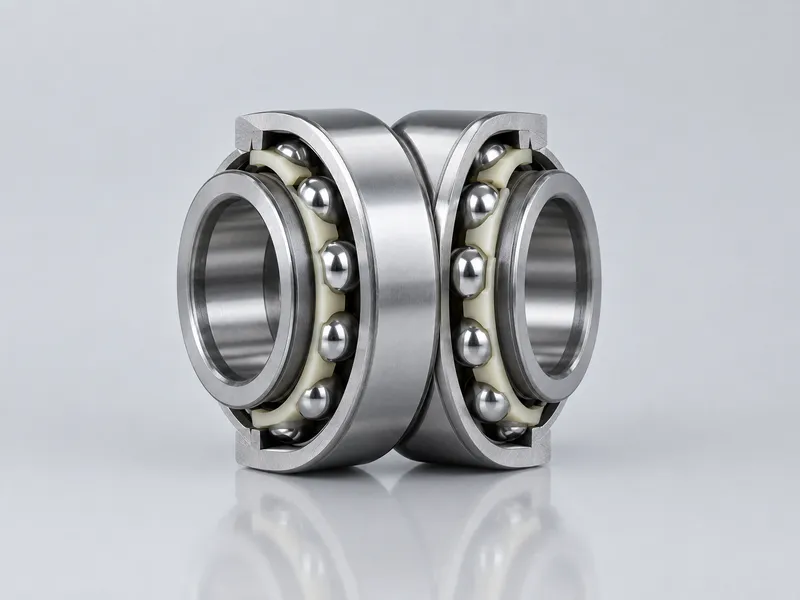
Angular contact ball bearings carry combined radial and axial load in one dominant direction. The contact angle between the raceway and the ball means a radial load always induces an internal axial component, so single bearings are mounted either in pairs or against a second bearing that takes the opposing axial force. Typical service: pump spindles, machine-tool spindles, compressors and high-speed motor heads where axial stiffness matters.
The 7200-series “B” execution in this page’s designation denotes the standard 40° contact angle. Where axial capacity in one direction is the dominant requirement, this is the usual series choice; duplex pairing arrangements (back-to-back, face-to-face or tandem) extend the capacity or stiffness in a controlled way.
How to read the specification table
The specification table’s load ratings and limiting speeds are catalog values for the designation, established for the manufacturer’s execution. In practice the working capacity of an angular-contact position is set by the pairing arrangement and preload, which the catalog numbers of a single bearing do not express — size the position as an arrangement, not as a single bearing.
Precision class and internal fit decisions matter more for this type than for deep groove bearings, because the running accuracy of the spindle depends on them. If your application calls for a paired set or a precision class above the standard execution, state it in the RFQ so the offer matches the arrangement you need.
Do not translate a bearing precision class into the same-number shaft or housing machining grade. SKF’s general bearing-interface guidance separates bearing accuracy from seat accuracy: for its stated high-speed/running-accuracy application, the 2018 catalogue Table 2 recommends shaft seats IT4 with radial run-out IT3/2 and abutment axial run-out IT3 for P5 bearings; the corresponding housing values are IT5, IT4/2 and IT4. Its P6 row is looser (shaft IT5 / IT4/2 / IT4; housing IT6 / IT5/2 / IT5). These are SKF application recommendations, not a universal rule that every P5 bearing requires those exact seat grades, and they do not replace selecting the fit from load, rotation and operating conditions. NSK independently explains why the seat is a separate control: shaft-to-inner-ring and housing-to-outer-ring fits are set by mating dimensions and tolerances; interference reduces residual internal clearance after mounting, and the inner/outer-ring temperature difference can reduce effective operating clearance further. Therefore “P5” alone cannot approve a replacement assembly or define its machining drawing. In the RFQ, state the bearing’s dimensional and running-accuracy class separately from shaft-seat and housing-bore fit classes, radial seat run-out, abutment axial run-out, operating temperature and target mounted clearance/preload. At incoming inspection, request the maker’s bearing tolerance record and measure the mating seats against the agreed drawing; do not label the shaft or housing simply “P5”.
A P5 mark and a DB / DF / DT arrangement code answer different questions. P5 identifies a dimensional / running-accuracy tolerance class; DB means back-to-back, DF face-to-face and DT tandem. Neither P5 nor the arrangement code by itself proves that two individually purchased bearings are a factory-matched pair, have a specified pair preload, or will share load evenly. NSK explicitly warns that individually controlled single-row bearings can vary when combined, while a matched arrangement has its clearance and precision controlled as a set. Do not accept “same size + same P5 + DB” as a complete replacement specification.
Manufacturer suffixes for pair-ready products are not interchangeable dictionaries. SKF distinguishes universal-match single bearings (its G family, with preload variants by series) from matched sets; its super-precision catalogue says matched bearings are paired during production and their bore / outside diameters are matched to within one-third of the permitted diameter tolerance. Schaeffler’s printing-machinery 72-..-B examples use UL for slight preload in O / X pairs and UO for a clearance-free pair. These are manufacturer- and product-range-specific constructions, not a universal UL = G = DB mapping. SKF also states that preload values are not standardized and depend on series, contact angle, internal geometry and size. Confirm the exact maker, series, suffix definition and published pair preload rather than translating suffixes across brands.
Choose the arrangement from the load path before choosing the pair: DB (back-to-back) supports axial load in both directions and offers a wider effective support span for moment stiffness; DF (face-to-face) also supports both axial directions but has a shorter span and is less suitable for moment load; DT (tandem) shares load for axial duty in one direction only. A DT pair alone is not a substitute where axial load reverses unless an opposing bearing arrangement is added. Preload is a separate selection from arrangement and must be confirmed for the exact series and size.
For an RFQ, state the exact manufacturer and full designation; contact angle / internal design; P class and the required runout or accuracy characteristic; number of individual bearings versus number of sets; DB / DF / DT orientation; universal-match or factory-matched-set status; target pair preload or axial clearance and its measurement condition; shaft / housing fits; operating speed, radial / axial load directions and temperature. Request the maker’s pair-level matching evidence (preload / clearance, bore and outside-diameter matching, width / standout or equivalent controlled dimensions, set identity and mounting order) and the lot-specific inspection record. If the supplier cannot document pair matching, treat the offer as two single bearings requiring an engineered adjustment procedure — not as a drop-in matched pair.
Related engineering knowledge
Background reading that supports the selection decision on this page — failure modes, seal trade-offs and lubrication behavior. These articles explain the engineering; the specifications and supply commitments live on this page and in the quotation.
7211B — buying questions
What does the designation 7211B mean?
7211B is a standard boundary-dimension designation: the dimension series fixes the outside diameter and width proportions, and the bore code fixes the bore diameter — 55 mm for this bearing. Two bearings carrying the same designation from conforming manufacturers are dimensionally interchangeable; execution (seals, clearance class, cage) is the part that can differ, so state the execution you need when you request a quotation.
Are the catalog load rating and speed of 7211B enough for my application?
The table lists Basic dynamic load rating (Cr) = 57.7 kN and grease-lubricated limit 4500 min-1 and oil-lubricated limit 6000 min-1. The load rating is the starting point of a life calculation, and each speed is a catalog limit for the manufacturer’s execution, not an application operating recommendation. Seals, fits, temperature and lubrication all affect the usable speed in a real assembly. Both lubricant-specific limits are listed; compare each only under its stated lubricant and manufacturer execution. Send the application conditions with your inquiry and we confirm suitability before quoting; do not size from the catalog speed alone.
What information do you need to quote 7211B?
Four things, in one message: the designation (and execution — seals, clearance class, precision class, if not standard), the quantity, the destination country, and any documents you require. Application conditions such as speed, load direction and temperature are welcome and let us verify the execution instead of assuming it. Quotation, lead time and the exact document set come back in writing.
Ordering & documentation
Documents
The documents available for 7211B depend on the actual supplying source and order. State any required export, origin, material or inspection documents in your inquiry; the available document set is confirmed in writing with the quotation.
Quotation
To quote 7211B, send: the designation and required execution, quantity, destination country, and any required documents. Adding the application conditions (speed, load direction, temperature, fit) lets us confirm the execution and clearance class instead of quoting blind.
Sample & supply
If you need an evaluation sample of 7211B, state the required quantity and timing. Sample feasibility, source, price and dispatch timing are confirmed in the quotation; sample availability is not assumed from the standard designation alone.
Lead time for this designation and quantity is confirmed in the quotation against the actual supplying source and availability. Any applicable certificates and quality documents are confirmed for the actual supplying source and product; available documents are stated in the quotation.
Storage & shipping
Store bearings flat in their original, unopened packaging in a dry indoor area away from temperature swings. Confirm the actual preservation method, packaging, marking and transport protection for the supplying source and order before shipment. Do not rotate a bearing through its rolling elements during handling or mounting.