
Angular Contact Ball Bearings
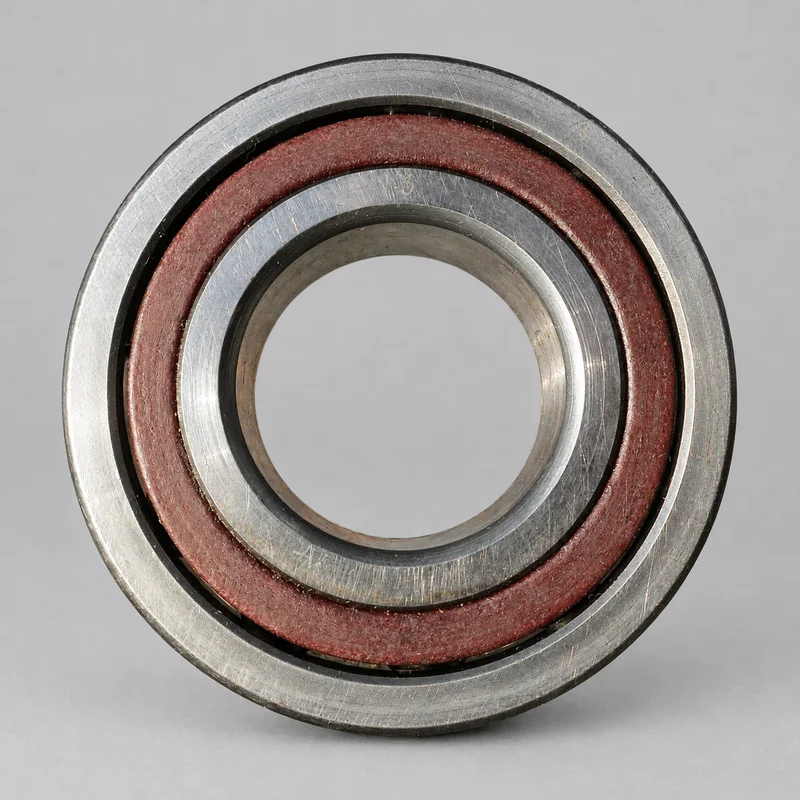
Angular contact ball bearing 7204B
Angular contact ball bearing 7204B, single-row, pressed cage, boundary dimensions 20 mm × 47 mm × 14 mm. Specifications below are model-bound published values; the source class is identified for each parameter. Send your application details through the RFQ for a confirmed quotation.
Last updated: 2026-11
Specifications
| Specification | Value | Parameter class | Source publisher |
|---|---|---|---|
| Bore diameter (d) | 20 mm | Model designation & boundary dimension | koyo.jtekt.co.jpManufacturer-published specification |
| Outside diameter (D) | 47 mm | Model designation & boundary dimension | koyo.jtekt.co.jpManufacturer-published specification |
| Width (B) | 14 mm | Model designation & boundary dimension | koyo.jtekt.co.jpManufacturer-published specification |
| Basic dynamic load rating (Cr) | 17.6 kN Basic dynamic load rating is a catalog reference used in bearing-life calculations; confirm equivalent load, speed, reliability and required service life for the application. | Manufacturer catalog reference — not a supply guarantee | koyo.jtekt.co.jpManufacturer-published specification |
| Basic static load rating (C0r) | 8.4 kN Basic static load rating is a catalog reference; verify equivalent static load and the required static safety factor for the application. | Manufacturer catalog reference — not a supply guarantee | koyo.jtekt.co.jpManufacturer-published specification |
| Fatigue load limit (Cu) | 0.55 kN Fatigue load limit is a catalog reference, not a standalone allowable-load or service-life guarantee; verify application duty and lubrication conditions. | Manufacturer catalog reference — not a supply guarantee | koyo.jtekt.co.jpManufacturer-published specification |
| Limiting speed, grease lubrication | 10000 min-1 Catalog limiting speed for grease lubrication, not an application operating recommendation. Confirm lubricant, temperature, load, sealing and duty conditions before selection. | Manufacturer catalog reference — not a supply guarantee | koyo.jtekt.co.jpManufacturer-published specification |
| Limiting speed, oil lubrication | 13000 min-1 Catalog limiting speed for oil lubrication, not an application operating recommendation. Confirm lubricant, temperature, load, sealing and duty conditions before selection. | Manufacturer catalog reference — not a supply guarantee | koyo.jtekt.co.jpManufacturer-published specification |
| Minimum chamfer (r min.) | 1 mm | Model designation & boundary dimension | jtekt.co.jpManufacturer-published specification |
| Minimum chamfer (r1 min.) | 0.6 mm | Model designation & boundary dimension | jtekt.co.jpManufacturer-published specification |
| Load center distance (a) | 21.5 mm | Model designation & boundary dimension | jtekt.co.jpManufacturer-published specification |
| Shaft abutment diameter (da min.) | 25.5 mm | Model designation & boundary dimension | jtekt.co.jpManufacturer-published specification |
| Housing abutment diameter (Da max.) | 41.5 mm | Model designation & boundary dimension | jtekt.co.jpManufacturer-published specification |
| Fillet radius (r max.) | 1 mm | Model designation & boundary dimension | jtekt.co.jpManufacturer-published specification |
| Reference mass | 0.112 kg | Manufacturer catalog reference — not a supply guarantee | jtekt.co.jpManufacturer-published specification |
Parameter classes: Model designation & boundary dimension — what identifies the model (boundary dimensions follow the designation). Manufacturer catalog reference — the named manufacturer's published catalog data for this designation; it is not a guarantee that every unit we supply reaches these exact figures. Industry reference — a third-party or industry-published value; it is not specific to the named manufacturer and is not a supply guarantee. Supplier-confirmed — a value we have confirmed for our own supply. Order-confirmed — the value fixed in a specific order. None of the values on this page are supplier-confirmed yet; supply-specific figures (tolerance class, clearance, seal variant availability, lead time) are confirmed with your quotation.
The source publisher shown on each row identifies where that parameter was published; it is not necessarily the manufacturer supplying your order. Manufacturer-published specifications are linked where the source is approved for public linking. Industry-reference publishers are shown as text.
All values above are model-bound catalog values traceable to a collected source. Fields without collected evidence are not published; ask with your inquiry and we confirm them at quotation.
Manufacturer / model attribution: Koyo / JTEKT — 7204B (single-row, pressed cage). This is the manufacturer named by the model-evidence record; it does not establish that every item supplied for an inquiry comes from this manufacturer. The actual manufacturer, original model and supplying source are confirmed in the quotation.
Source per specification field
| Specification | Source |
|---|---|
| Bore diameter (d) | koyo.jtekt.co.jp — manufacturer-published specification |
| Outside diameter (D) | koyo.jtekt.co.jp — manufacturer-published specification |
| Width (B) | koyo.jtekt.co.jp — manufacturer-published specification |
| Basic dynamic load rating (Cr) | koyo.jtekt.co.jp — manufacturer-published specification |
| Basic static load rating (C0r) | koyo.jtekt.co.jp — manufacturer-published specification |
| Fatigue load limit (Cu) | koyo.jtekt.co.jp — manufacturer-published specification |
| Limiting speed, grease lubrication | koyo.jtekt.co.jp — manufacturer-published specification |
| Limiting speed, oil lubrication | koyo.jtekt.co.jp — manufacturer-published specification |
| Minimum chamfer (r min.) | jtekt.co.jp — manufacturer-published specification |
| Minimum chamfer (r1 min.) | jtekt.co.jp — manufacturer-published specification |
| Load center distance (a) | jtekt.co.jp — manufacturer-published specification |
| Shaft abutment diameter (da min.) | jtekt.co.jp — manufacturer-published specification |
| Housing abutment diameter (Da max.) | jtekt.co.jp — manufacturer-published specification |
| Fillet radius (r max.) | jtekt.co.jp — manufacturer-published specification |
| Reference mass | jtekt.co.jp — manufacturer-published specification |
7204B P5 — the dimensional class and running-accuracy class must be checked separately
Buyer conclusion: do not approve a 7204B replacement from the shorthand label P5 alone. For the same 20 × 47 × 14 mm envelope and 40° contact angle, NSK 7204BWP5 identifies P5 as ISO 492 Class 5, while SKF 7204 BECBP identifies P6 dimensional tolerance and P5 geometrical tolerance. These are not the same complete tolerance envelope. The difference matters when the fit depends on bore, outside diameter or ring width, rather than only on running accuracy.
| Manufacturer and exact execution | Nominal identity | Published accuracy evidence | What can be concluded |
|---|---|---|---|
| NSK 7204BWP5 | 20 × 47 × 14 mm; 40°; pressed-steel cage | Product record states tolerance P5. NSK designation guide defines P5 as ISO 492 tolerance Class 5. | Class 5 is explicitly stated for this exact NSK execution. Keep the full 7204BWP5 designation in the RFQ and receiving record. |
| SKF 7204 BECBP | 20 × 47 × 14 mm; 40°; SKF Explorer; single bearing suitable for universal matching | Product record lists P6 dimensional tolerance and P5 geometrical tolerance. It also publishes separate bore, outside-diameter, width and run-out fields. | This is a split accuracy specification: P5 geometrical accuracy does not upgrade its dimensional tolerance from P6 to P5. |
| Koyo / JTEKT 7204B | 20 × 47 × 14 mm; 40°; pressed cage | The exact standard product record lists dimensions and performance but does not state a precision class. JTEKT separately states that its precision angular-contact bearings use JIS B 1514 Classes 5, 4 and 2. | The standard 7204B record does not establish Class 5. The precision catalogue statement must not be transferred to an unqualified standard product record. |
| NTN 7204B | 20 × 47 × 14 mm; 40°; pressed-steel cage | The exact standard product record does not state a precision class. NTN 2024 general catalogue directs JIS Class 5 or higher angular-contact bearings to its separate precision-bearing catalogue. | The standard 7204B record does not establish Class 5. Ask for the exact precision execution and its certificate rather than inferring a class from the base number. |
Cross-source finding: the important difference is not a claim that one maker is universally more accurate. NSK uses P5 as a direct ISO 492 class designation for 7204BWP5. SKF applies different classes to different characteristic groups on the Explorer 7204 BECBP: P6 for dimensions and P5 for geometry. JTEKT and NTN publish a standard 7204B with the same nominal envelope and angle but do not declare a precision class on the cited product record; both manufacturers separate precision-class products into dedicated product guidance or catalogues. A missing class declaration is unknown, not proof of Class 0 and not proof of P5.
Why this changes substitution and machining: if the assembly depends on shaft fit, housing fit or axial stack-up, a P5 run-out statement alone is insufficient. A candidate with P6 dimensional tolerance can have a different bore or outside-diameter acceptance window from a full Class 5 candidate even when its geometrical tolerance is P5. Conversely, a buyer who only checks bore and outside diameter can miss the running-accuracy requirement. The purchase specification must name the characteristic group and its required limit, not just the grade label.
RFQ and receiving checks
- Write the complete manufacturer and designation, including every suffix; do not write only 7204B or P5.
- State the required ISO 492 or JIS B 1514 edition and list dimensional tolerances separately from geometrical or running-accuracy tolerances.
- For dimensions, request actual or guaranteed limits for mean bore diameter, mean outside diameter and ring width.
- For running accuracy, identify the required inner-ring and outer-ring run-out or perpendicularity characteristics, with the specified measurement method and load.
- Request a lot-linked inspection report showing measured values, instrument method, reference temperature and the bearing identification. A catalogue class statement is not a batch measurement certificate.
- Keep pair matching, preload, arrangement and assembly sequence as separate purchase requirements; this tolerance comparison does not approve a matched-pair substitute.
Scope and limits: this comparison is limited to the cited 20 × 47 × 14 mm, 40° executions and the precision-class statements visible in the linked manufacturer records. It does not establish identical internal design, universal interchangeability, matched-pair preload, actual batch measurements or machine-level run-out. The JTEKT and NTN standard 7204B product records do not disclose a precision class in the cited pages; no class has been inferred. No common-condition measurement comparison between the four manufacturers was found.
References: NSK, 7204BWP5 Single-Row Angular Contact Ball Bearing, exact product record: NSK 7204BWP5; NSK, Bearing Designation Systems, 2024, Table 3.9, P5 = ISO 492 Class 5: NSK designation guide PDF; SKF, 7204 BECBP, exact product record with P6 dimensions and P5 geometrical tolerance: SKF 7204 BECBP; SKF, Rolling bearings, angular-contact section, bearing data table, dimensional and geometrical tolerance split: SKF catalogue PDF; Koyo / JTEKT, 7204B, exact product record: JTEKT 7204B; JTEKT, Bearing number, Table 6-2, B = 40° contact angle: JTEKT bearing-number guide; JTEKT, Precision Ball & Roller Bearings, CAT. NO. BA005EN-1DS, Section II.1.4, precision angular-contact tolerance classes: JTEKT precision catalogue PDF; NTN, 7204B, exact product record: NTN 7204B; NTN, Ball and Roller Bearings, CAT. No. 2203-3/E, 2024, A-6 note directing Class 5 and higher angular-contact bearings to the precision catalogue: NTN catalogue PDF.
7204B execution comparison — same envelope, different bearing positions
JTEKT publishes several distinct 20 × 47 mm angular-contact executions. The table below keeps each designation and arrangement separate: the matched-pair 7204BDB is 28 mm wide overall, not a single-bearing replacement for the 14 mm-wide 7204B. Load ratings and limiting speeds belong to the exact catalogue execution shown.
| JTEKT designation | Construction / arrangement | d × D × B (mm) | Cr / C0r / Cu (kN) | Grease / oil limit (min⁻¹) | Load centre a (mm) |
|---|---|---|---|---|---|
| 7204 | Single-row, pressed cage | 20 × 47 × 14 | 19.2 / 9.15 / 0.640 | 13,000 / 17,000 | 17.0 |
| 7204B | Single-row, pressed cage; B execution | 20 × 47 × 14 | 17.6 / 8.40 / 0.550 | 10,000 / 13,000 | 21.5 |
| 7204B FY | Single-row, machined cage | 20 × 47 × 14 | 16.6 / 7.70 / 0.500 | 13,000 / 17,000 | 21.5 |
| 7204BDB | Matched pair, back-to-back, pressed cage | 20 × 47 × 28 overall | 28.6 / 16.8 / 1.10 | 8,000 / 11,000 | 42.9 |
How to use this comparison: 7204 and 7204B share the same boundary dimensions but have different load ratings, limiting speeds and load-centre positions in JTEKT's catalogue. 7204B FY keeps the 7204B load-centre value but is a separately named machined-cage execution with its own ratings. 7204BDB is a factory-matched back-to-back pair with twice the single-bearing width; its pair ratings must not be divided or treated as a single-bearing rating.
These are catalogue comparisons, not a declaration that the executions are interchangeable or currently held in stock. Confirm contact-angle requirement, mounting arrangement, preload, precision, clearance, lubricant, seal/open execution and actual manufacturer against the RFQ and quotation. JTEKT's public product pages do not publish the steel grade, cage material, model-specific internal clearance or precision class for these entries; those fields remain unassigned here.
Source: JTEKT 7204; JTEKT 7204B; JTEKT 7204B FY; JTEKT 7204BDB. Values transcribed from the manufacturer's designation-specific product records.
7204B paired arrangement and preload — DB is an arrangement, not a preload specification
Buyer conclusion: do not approve a replacement for a 7204BDB by matching only the 20 × 47 mm envelope, a 40° contact angle, or the letters DB. DB describes a back-to-back arrangement; it does not, by itself, state the pair's axial clearance, preload magnitude, matching tolerance or whether two loose single bearings may be combined. A universal-matching single bearing is a different supply state from a factory-matched DB pair.
| Manufacturer / exact record | What the record establishes | What it does not establish | Replacement implication |
|---|---|---|---|
| Koyo / JTEKT 7204BDB | Matched pair; back-to-back; pressed cage; 20 × 47 × 28 mm overall; 40° B execution in the 7204B family; Cr 28.6 kN, C0r 16.8 kN, Cu 1.10 kN; grease limiting speed 8,000 min⁻¹; load-centre spread 42.9 mm | Public product record does not state a numeric pair preload, axial clearance, matching tolerance or a batch measurement certificate | Buy and receive as a pair with the exact DB arrangement and written confirmation of its matched condition; do not split the pair rating into two assumed single-bearing ratings |
| SKF 7204 BECBP | Single-row bearing; 20 × 47 × 14 mm; 40°; P6; SKF says universal matching is available; matched arrangement is “No”; matched condition is axial clearance CB | It is not itself a factory-configured two-bearing DB set; its CB condition is not a JTEKT 7204BDB preload value | Two SKF universal-matching singles may be arranged according to SKF's matching rules, but that does not make one SKF single a replacement for the JTEKT pair or establish equivalent pair stiffness/load rating |
| NSK 7204ATYNSULP4 | Single-row high-precision universal single (SU); 20 × 47 × 14 mm; 30° contact angle; P4; standard light preload (L); product page lists its own preload / rigidity values for DB and DF arrangements | It is not the 40° JTEKT 7204B execution; NSK's SU and L designations belong to this NSK precision series and are not JTEKT suffix equivalents | Reject a dimension-only cross-reference where contact angle and precision family differ; specify the angle and preload target explicitly |
Why the same letters do not settle the pairing question
JTEKT's precision-bearing catalogue separates combination geometry (DB / DF / DT) from preload symbols (S / L / M / H). It describes matched pairs as preset for a defined preload and axial-clearance condition. Its Type G flush-ground singles are a special case: both ring faces are ground to controlled stand-out so that the specified preload can be obtained with any combination. JTEKT also instructs installers to align the outer-ring V marks for the intended combination. Therefore, “DB” alone is not evidence that two unmarked loose bearings are interchangeable with a matched pair.
NSK's high-precision designation guide makes a similar distinction in its own system: SU means a single universal bearing, DU means a duplex universal set, while DB / DF / DT identify duplex arrangements; L / M / H are separate preload symbols. The shared DB / DF / DT geometry vocabulary is useful for understanding the arrangement, but the universal-matching status and preload class remain manufacturer- and series-specific.
The JTEKT preload table often quoted for matched angular-contact pairs is explicitly for JIS Class 5 or higher high-precision bearings used in machine-tool spindle applications. Its S / L / M / H values must not be copied onto the standard 7204BDB product record without proof that the exact ordered execution belongs to that table's scope. JTEKT itself warns that preload affects rigidity but also bearing life, temperature and friction torque; wear-in, shaft/housing accuracy, mounting and lubrication can reduce or alter the installed preload.
RFQ and incoming-inspection questions
- Is the requested item one single bearing, two universal-matching singles, or a factory-matched pair? State the required quantity as bearings or pairs.
- Confirm the exact arrangement: DB (back-to-back), DF (face-to-face) or DT (tandem), and the required direction of axial load / moment stiffness.
- State the required contact angle in degrees, not only the suffix letter B / A / C.
- Require the manufacturer to state the pair's unmounted axial clearance or preload class and numeric value, plus the measurement method / measuring load and allowable matching tolerance.
- For universal-matching singles, require written confirmation that the exact model and suffix are intended for random pairing in the specified arrangement; do not infer this from DB / DF / DT alone.
- Specify precision class, cage, lubricant, speed, operating temperature, shaft/housing fits and the assembled axial rigidity / runout target.
- At receipt, retain the original pair packaging, pair identity / matching marks, orientation marks and individual bearing serial or lot identifiers. Do not mix one bearing from another pair unless the manufacturer explicitly permits it.
Scope and limits: this is a designation and supply-state comparison, not an approval to replace JTEKT 7204BDB with SKF or NSK products. The JTEKT 7204BDB product record identifies a matched back-to-back pair but does not publish its numeric preload / clearance. The SKF 7204 BECBP record describes a universal-matching single with CB axial clearance. The NSK 7204ATYNSULP4 record is a 30° P4 precision single with L preload and is included only to demonstrate that the same 20 × 47 × 14 mm envelope can carry a different contact-angle and precision execution. No common-condition stiffness, fatigue, speed or service-life test was found; no cross-brand interchangeability is claimed.
Sources: Koyo / JTEKT, official 7204BDB product record (matched pair, back-to-back, pressed cage, 20 × 47 × 28 mm, Cr 28.6 kN, C0r 16.8 kN, Cu 1.10 kN, grease limit 8,000 min⁻¹; accessed 2026-11-25); JTEKT, Basic Bearing Knowledge, Section 6-3 “Bearing number”, angular-contact bearing code B = 40° (accessed 2026-11-25): Open JTEKT designation guidance. Koyo / JTEKT, Precision Ball & Roller Bearings, CAT. NO. BA005EN-1DS, Section 1.2, printed pp. 66–67 (matched-pair preset preload / axial clearance, Type G flush-ground combination, DB/DF/DT and V-mark assembly); Section 1.3, printed p. 68 (preload symbols S/L/M/H and combination symbols); Section 1.5, printed p. 73 (preload effects and scope of standard preload classes). Open JTEKT catalogue. JTEKT, Basic Bearing Knowledge, Section 11-4-1, Table 11-2 (recommended preload only for JIS Class 5 or higher high-precision matched pairs in machine-tool spindle applications; accessed 2026-11-25). Open JTEKT preload guidance. SKF, official 7204 BECBP product record (20 × 47 × 14 mm, 40°, P6, universal matching = yes, matched arrangement = no, axial clearance CB; accessed 2026-11-25). NSK, official 7204ATYNSULP4 product record (20 × 47 × 14 mm, 30°, P4, L preload; accessed 2026-11-25); NSK, Bearing Replacement Guide, “Super Precision Angular Contact Bearings for Machine Tools”, printed pp. 256–257, designation tables (SU / DU vs DB / DF / DT; preload L/M/H); Open NSK guide.
Applications and selection notes
Angular contact ball bearings carry combined radial and axial load in one dominant direction. The contact angle between the raceway and the ball means a radial load always induces an internal axial component, so single bearings are mounted either in pairs or against a second bearing that takes the opposing axial force. Typical service: pump spindles, machine-tool spindles, compressors and high-speed motor heads where axial stiffness matters.
The 7200-series “B” execution in this page’s designation denotes the standard 40° contact angle. Where axial capacity in one direction is the dominant requirement, this is the usual series choice; duplex pairing arrangements (back-to-back, face-to-face or tandem) extend the capacity or stiffness in a controlled way.
How to read the specification table
The specification table’s load ratings and limiting speeds are catalog values for the designation, established for the manufacturer’s execution. In practice the working capacity of an angular-contact position is set by the pairing arrangement and preload, which the catalog numbers of a single bearing do not express — size the position as an arrangement, not as a single bearing.
Precision class and internal fit decisions matter more for this type than for deep groove bearings, because the running accuracy of the spindle depends on them. If your application calls for a paired set or a precision class above the standard execution, state it in the RFQ so the offer matches the arrangement you need.
Do not translate a bearing precision class into the same-number shaft or housing machining grade. SKF’s general bearing-interface guidance separates bearing accuracy from seat accuracy: for its stated high-speed/running-accuracy application, the 2018 catalogue Table 2 recommends shaft seats IT4 with radial run-out IT3/2 and abutment axial run-out IT3 for P5 bearings; the corresponding housing values are IT5, IT4/2 and IT4. Its P6 row is looser (shaft IT5 / IT4/2 / IT4; housing IT6 / IT5/2 / IT5). These are SKF application recommendations, not a universal rule that every P5 bearing requires those exact seat grades, and they do not replace selecting the fit from load, rotation and operating conditions. NSK independently explains why the seat is a separate control: shaft-to-inner-ring and housing-to-outer-ring fits are set by mating dimensions and tolerances; interference reduces residual internal clearance after mounting, and the inner/outer-ring temperature difference can reduce effective operating clearance further. Therefore “P5” alone cannot approve a replacement assembly or define its machining drawing. In the RFQ, state the bearing’s dimensional and running-accuracy class separately from shaft-seat and housing-bore fit classes, radial seat run-out, abutment axial run-out, operating temperature and target mounted clearance/preload. At incoming inspection, request the maker’s bearing tolerance record and measure the mating seats against the agreed drawing; do not label the shaft or housing simply “P5”.
A P5 mark and a DB / DF / DT arrangement code answer different questions. P5 identifies a dimensional / running-accuracy tolerance class; DB means back-to-back, DF face-to-face and DT tandem. Neither P5 nor the arrangement code by itself proves that two individually purchased bearings are a factory-matched pair, have a specified pair preload, or will share load evenly. NSK explicitly warns that individually controlled single-row bearings can vary when combined, while a matched arrangement has its clearance and precision controlled as a set. Do not accept “same size + same P5 + DB” as a complete replacement specification.
Manufacturer suffixes for pair-ready products are not interchangeable dictionaries. SKF distinguishes universal-match single bearings (its G family, with preload variants by series) from matched sets; its super-precision catalogue says matched bearings are paired during production and their bore / outside diameters are matched to within one-third of the permitted diameter tolerance. Schaeffler’s printing-machinery 72-..-B examples use UL for slight preload in O / X pairs and UO for a clearance-free pair. These are manufacturer- and product-range-specific constructions, not a universal UL = G = DB mapping. SKF also states that preload values are not standardized and depend on series, contact angle, internal geometry and size. Confirm the exact maker, series, suffix definition and published pair preload rather than translating suffixes across brands.
Choose the arrangement from the load path before choosing the pair: DB (back-to-back) supports axial load in both directions and offers a wider effective support span for moment stiffness; DF (face-to-face) also supports both axial directions but has a shorter span and is less suitable for moment load; DT (tandem) shares load for axial duty in one direction only. A DT pair alone is not a substitute where axial load reverses unless an opposing bearing arrangement is added. Preload is a separate selection from arrangement and must be confirmed for the exact series and size.
For an RFQ, state the exact manufacturer and full designation; contact angle / internal design; P class and the required runout or accuracy characteristic; number of individual bearings versus number of sets; DB / DF / DT orientation; universal-match or factory-matched-set status; target pair preload or axial clearance and its measurement condition; shaft / housing fits; operating speed, radial / axial load directions and temperature. Request the maker’s pair-level matching evidence (preload / clearance, bore and outside-diameter matching, width / standout or equivalent controlled dimensions, set identity and mounting order) and the lot-specific inspection record. If the supplier cannot document pair matching, treat the offer as two single bearings requiring an engineered adjustment procedure — not as a drop-in matched pair.
Related engineering knowledge
Background reading that supports the selection decision on this page — failure modes, seal trade-offs and lubrication behavior. These articles explain the engineering; the specifications and supply commitments live on this page and in the quotation.
7204B — buying questions
What does the designation 7204B mean?
7204B is a standard boundary-dimension designation: the dimension series fixes the outside diameter and width proportions, and the bore code fixes the bore diameter — 20 mm for this bearing. Two bearings carrying the same designation from conforming manufacturers are dimensionally interchangeable; execution (seals, clearance class, cage) is the part that can differ, so state the execution you need when you request a quotation.
Are the catalog load rating and speed of 7204B enough for my application?
The table lists Basic dynamic load rating (Cr) = 17.6 kN and grease-lubricated limit 10000 min-1 and oil-lubricated limit 13000 min-1. The load rating is the starting point of a life calculation, and each speed is a catalog limit for the manufacturer’s execution, not an application operating recommendation. Seals, fits, temperature and lubrication all affect the usable speed in a real assembly. Both lubricant-specific limits are listed; compare each only under its stated lubricant and manufacturer execution. Send the application conditions with your inquiry and we confirm suitability before quoting; do not size from the catalog speed alone.
What information do you need to quote 7204B?
Four things, in one message: the designation (and execution — seals, clearance class, precision class, if not standard), the quantity, the destination country, and any documents you require. Application conditions such as speed, load direction and temperature are welcome and let us verify the execution instead of assuming it. Quotation, lead time and the exact document set come back in writing.
Ordering & documentation
Documents
The documents available for 7204B depend on the actual supplying source and order. State any required export, origin, material or inspection documents in your inquiry; the available document set is confirmed in writing with the quotation.
Quotation
To quote 7204B, send: the designation and required execution, quantity, destination country, and any required documents. Adding the application conditions (speed, load direction, temperature, fit) lets us confirm the execution and clearance class instead of quoting blind.
Sample & supply
If you need an evaluation sample of 7204B, state the required quantity and timing. Sample feasibility, source, price and dispatch timing are confirmed in the quotation; sample availability is not assumed from the standard designation alone.
Lead time for this designation and quantity is confirmed in the quotation against the actual supplying source and availability. Any applicable certificates and quality documents are confirmed for the actual supplying source and product; available documents are stated in the quotation.
Storage & shipping
Store bearings flat in their original, unopened packaging in a dry indoor area away from temperature swings. Confirm the actual preservation method, packaging, marking and transport protection for the supplying source and order before shipment. Do not rotate a bearing through its rolling elements during handling or mounting.
7204B across JTEKT and NTN — load ratings and limiting speeds point in opposite directions
Buyer conclusion: do not rank or approve a 7204B replacement by comparing only Cr or catalogue rpm. JTEKT publishes the higher basic load ratings, while NTN publishes the higher grease- and oil-lubrication limiting speeds. The public evidence does not establish a common test/application basis that explains the gap.
| Original manufacturer / exact record | Boundary and contact angle | Cr / C0r / Cu | Grease / oil limiting speed | Cage / execution |
|---|---|---|---|---|
| Koyo / JTEKT 7204B | 20 × 47 × 14 mm; B code = 40° | 17.6 / 8.40 / 0.550 kN | 10,000 / 13,000 min⁻¹ | Single row; pressed cage |
| NTN 7204B | 20 × 47 × 14 mm; 40° stated explicitly | 13.3 / 7.70 / 0.605 kN | 15,000 / 20,000 min⁻¹ | Single row; pressed steel cage |
What the numbers say: JTEKT's published Cr is 4.3 kN (32.3%) higher than NTN's catalogue value, and its C0r is 0.70 kN (9.1%) higher. NTN's Cu is 0.055 kN (10.0%) higher, while its listed grease and oil limiting speeds are 50% and 53.8% higher than JTEKT's, respectively. These are arithmetic comparisons of published values, not measured performance differences, service-life ratios or permissible operating-speed guarantees.
Why the gap cannot be “averaged”: NTN's CAT. NO. 2202-(/E §3.2 defines basic dynamic load rating as the load corresponding to one million revolutions of basic rating life and states that its tabulated ratings assume NTN standard bearing materials and manufacturing techniques (printed p. A-17). Its speed table separately lists grease and oil limiting speeds. JTEKT's public 7204B record supplies Cr, C0r, Cu and lubricant-specific limiting speeds, but does not disclose enough model-level calculation/version detail to normalize those values to NTN's stated basis or to a common thermal/mechanical speed criterion. The cause remains unresolved; do not infer different steel, heat treatment, internal geometry or test quality from the figures alone.
Selection consequence: for load-dominated duty, ask both manufacturers to confirm the rating method/version and provide the application's equivalent dynamic load, static equivalent load and required-life calculation. For speed-dominated duty, require the exact speed definition and its load, lubricant viscosity/type, temperature, cage, fit, clearance and heat-dissipation assumptions. Neither catalogue limit alone approves the machine speed.
RFQ and receiving clarification
- State the exact maker and complete 7204B designation; a generic cross-reference is not OEM interchange approval.
- Request the current rating standard and edition, Cr/C0r calculation basis, and explanation of revised catalogue values.
- Request grease/oil limiting-speed definitions and reference assumptions, including lubricant, operating temperature, load, cage, fit, clearance and cooling.
- Provide radial/axial load spectrum, duty cycle, target life/reliability, shaft/housing fits, operating clearance, lubricant and heat-rejection conditions.
- At receiving, verify maker marking, full designation, cage execution and source-manufacturer attribution; do not accept “equivalent 7204B” as proof of matching performance.
Scope and limits: both records identify a 20 × 47 × 14 mm single-row 40° angular-contact bearing with pressed cage, but no common-condition test or maker-issued cross-reference approval was found. NTN's 2009 catalogue and current NTN product record agree on C0, Cu and speed values but disagree on Cr (13.3 vs 14.7 kN); the reason is not established. The comparison does not establish which bearing lasts longer, carries more load in a real machine, or can run at the other maker's speed. Cu is not a working-load limit, and catalogue limiting speed is not a universal safe operating speed.
Sources: Koyo / JTEKT, official 7204B product record (d 20 mm, D 47 mm, B 14 mm, Cr 17.6 kN, C0r 8.40 kN, Cu 0.550 kN, grease 10,000 min⁻¹, oil 13,000 min⁻¹; accessed 2026-11-25); JTEKT, Basic Bearing Knowledge, §6-3, angular-contact B code = 40°: designation guidance. NTN, Ball and Roller Bearings, CAT. NO. 2202-(/E, §3.2, printed p. A-17 (basic dynamic rating basis), angular-contact dimension table, printed p. B-46 (7204B row: Cr 13.3 kN, C0 7.70 kN, Cu 0.605 kN, grease 15,000 min⁻¹, oil 20,000 min⁻¹): NTN catalogue PDF; NTN-SNR official 7204B product record (20 × 47 × 14 mm, 40°, current performance values; accessed 2026-11-25).
7204A (30°) vs 7204B (40°) — rigidity and speed trade off; load rating does not rank by angle
Buyer conclusion: 7204A and 7204B share the 20 × 47 × 14 mm envelope, but the A / omitted-angle execution is 30° and the B execution is 40°. Do not treat them as a suffix-only drop-in replacement. A larger contact angle is associated with higher axial rigidity; the smaller angle is more favourable for high-speed rotation. However, the two manufacturers' same-size product pairs both publish higher basic dynamic and static load ratings for their 30° execution than for their 40° execution. Therefore “40° means more load capacity” is not a safe selection rule.
| Original manufacturer / paired comparison | 30° execution | 40° execution | Observed within-maker difference |
|---|---|---|---|
| Koyo / JTEKT | 7204 (7200 series): Cr 19.2 kN; C0r 9.15 kN; Cu 0.640 kN; grease 13,000 / oil 17,000 min⁻¹; load-centre spread a = 17.0 mm | 7204B (7200B series): Cr 17.6 kN; C0r 8.40 kN; Cu 0.550 kN; grease 10,000 / oil 13,000 min⁻¹; load-centre spread a = 21.5 mm | 30° record has +9.1% Cr, +8.9% C0r, +30.0% grease limit and +30.8% oil limit. 40° record's load-centre spread is 4.5 mm greater. |
| NSK | 7204AWP5: Cr 15.9 kN; C0r 8.30 kN; grease 13,000 / oil-bath 18,000 min⁻¹; effective load centre a = 16.7 mm; A = 30°; W = pressed steel; P5 | 7204BWP5: Cr 14.7 kN; C0r 7.65 kN; grease 9,500 / oil-bath 13,000 min⁻¹; effective load centre a = 21.1 mm; B = 40°; W = pressed steel; P5 | 30° record has +8.2% Cr, +8.5% C0r, +36.8% grease limit and +38.5% oil-bath limit. 40° record's effective load centre is 4.4 mm greater. |
What the cross-source pattern means — and what it does not mean
JTEKT's Precision Ball & Roller Bearings catalogue, Section II.1, printed p. 62, identifies 30° as the 7200 series (A omitted) and 40° as the 7200B series (B). It states that a larger contact angle increases axial rigidity, while a smaller contact angle is more advantageous for high-speed rotation. Its 7204 / 7204B product records show the corresponding speed and rating differences. NSK independently shows the same direction in its 7204AWP5 and 7204BWP5 records: both are 20 × 47 × 14 mm, both have pressed-steel cages and P5 tolerance, but their contact angles, load ratings, limiting speeds and effective load-centre positions differ.
The agreement across two manufacturers supports a selection trade-off, not a universal performance law: for these exact 7204 executions, the 30° versions have higher published basic load ratings and speed limits, while JTEKT's design guidance associates 40° with higher axial rigidity. The load-centre distance also shifts by about 4.4–4.5 mm within each maker's own pair. Do not compare JTEKT's “load centre spread” directly with NSK's “effective load centre” as if they were a common measurement protocol; the useful comparison here is the direction and magnitude of each manufacturer's own A-to-B change.
Important limit: Cr and C0r are basic rating values, not allowable axial load, axial stiffness, service life or proof that one angle is “stronger” in every application. The product pages do not provide a matched, same-condition axial load–displacement test for the two angles. JTEKT's rigidity guidance is qualitative at the series level; no numerical stiffness ratio for the exact 7204 and 7204B was found. A 40° selection still needs the manufacturer's permissible axial-load check, the actual preload/arrangement, and the required duty-cycle speed assessment.
Selection and RFQ checks
- Write the required contact angle in degrees (30° or 40°), not just “7204” or “7204B”; confirm the original manufacturer designation.
- For high-speed duty, compare the exact grease or oil-bath / oil-air speed rating and its assumptions; do not transfer the 30° catalogue limit to the 40° version.
- For axial-rigidity duty, request the manufacturer's axial load–displacement curve or calculated displacement at the actual preload, load and temperature; do not use Cr as a stiffness proxy.
- For combined loads, request the correct angle- and arrangement-specific equivalent-load factors and life calculation. Do not reuse 30° factors for a 40° bearing.
- Confirm the effective load-centre dimension, shaft/housing shoulder geometry, spacer dimensions and paired arrangement before machining or approving a replacement.
- At receipt, verify the full maker marking and suffix; equal d × D × B dimensions do not establish contact-angle, load-centre, speed or axial-rigidity equivalence.
Scope and limits: this comparison is limited to the exact published 7204 and 7204B records from Koyo / JTEKT and 7204AWP5 and 7204BWP5 records from NSK. It does not compare different manufacturers' load ratings against one another, certify cross-brand interchangeability, or establish an allowable axial load or actual operating speed. The NSK pair has the same stated cage type and P5 tolerance, which helps isolate the contact-angle execution within that maker's records; it does not make the two models identical in all internal geometry. JTEKT's product records identify both as single-row bearings with pressed cages. No common-condition endurance, temperature, vibration or stiffness test was found.
Sources: Koyo / JTEKT, official 7204 product record (20 × 47 × 14 mm; Cr 19.2 kN; C0r 9.15 kN; Cu 0.640 kN; grease 13,000 min⁻¹; oil 17,000 min⁻¹; a = 17.0 mm; accessed 2026-11-25) and 7204B product record (20 × 47 × 14 mm; Cr 17.6 kN; C0r 8.40 kN; Cu 0.550 kN; grease 10,000 min⁻¹; oil 13,000 min⁻¹; a = 21.5 mm; accessed 2026-11-25); JTEKT, Precision Ball & Roller Bearings, CAT. NO. BA005EN-1DS, Section II.1 “Angular Contact Ball Bearings”, printed p. 62 (30° / 40° designation and axial-rigidity / speed guidance). Open JTEKT catalogue. NSK, official 7204AWP5 product record (20 × 47 × 14 mm; 30°; W pressed-steel cage; P5; Cr 15.9 kN; C0r 8.30 kN; grease 13,000 min⁻¹; oil-bath 18,000 min⁻¹; a = 16.7 mm; accessed 2026-11-25) and 7204BWP5 product record (20 × 47 × 14 mm; 40°; W pressed-steel cage; P5; Cr 14.7 kN; C0r 7.65 kN; grease 9,500 min⁻¹; oil-bath 13,000 min⁻¹; a = 21.1 mm; accessed 2026-11-25).