
Deep groove ball bearings
6900 Series (extra thin section) — Deep Groove Ball Bearings
The 6900 series shelf: 21 published designations, each with its own model-bound specification page. The ranges below are the span across exactly those published models — not a family-wide promise. Open a designation for its full table, or send the designation you need with your application details.
Last updated: 2026-11
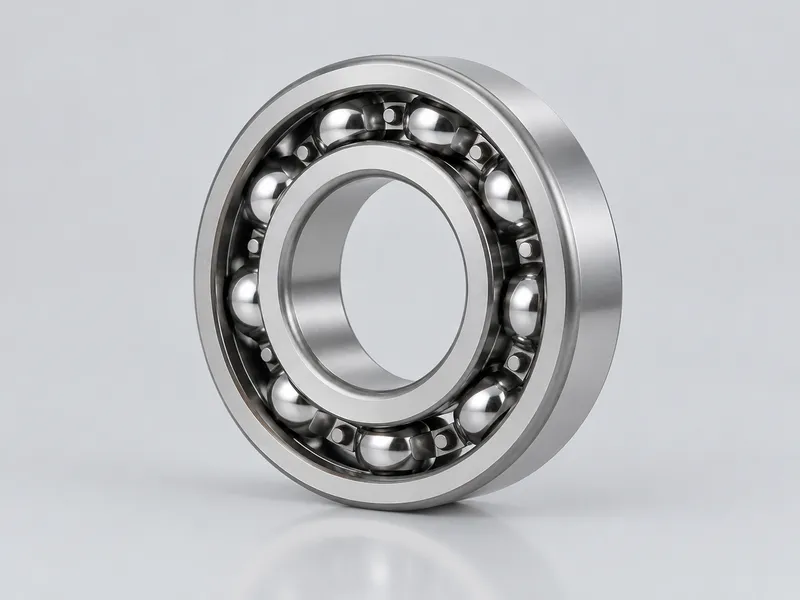
6900 series dimension and load range
| Attribute | Range across published models |
|---|---|
| Bore diameter (d) | 10 – 100 mm |
| Outside diameter (D) | 22 – 140 mm |
| Width (B) | 6 – 20 mm |
| Basic dynamic load rating (Cr) | 3.35 – 56.2 kN |
| Basic static load rating (C0r) | 1.25 – 41.9 kN |
Each span is the minimum and maximum over the 21 published model pages listed below, whose values are model-bound catalog figures traceable to a collected source. The series page adds no numbers of its own; a designation not listed here is not yet published with evidence, and we confirm it at quotation on request.
Published 6900-series models
Every designation below links to its own specification page — dimensions, load ratings, speeds and ordering notes per model.
Choosing inside the 6900 series
The 619xx series is the thin section one grade up from 618xx: like all thin-wall series its rings are significantly smaller and narrower at the same bore than the 60, 62 and 63 series (CW Bearing thin-wall series note, collected 2026-11-16), but it gives back part of the section that the extra-thin line spends — capacity and rigidity that show up directly in heavier or more continuous duty.
When does 6900 beat 618xx at the same bore?
619xx is the default thin-wall answer when the extra-thin section leaves too little margin — heavier or continuous duty, a shaft that needs more support stiffness, or an assembly where fit and clamping practice cannot be held to extra-thin discipline — while the packaging still rules out a standard section. The wrong turns are symmetric and both cost money: specifying 619xx where the envelope had room for 618xx wastes the space the buyer was protecting; specifying 618xx where the duty needed 619xx converts a section choice into a service failure unless the load estimate was conservative by the whole section difference.
What moves the fitted clearance after assembly?
Interference fits move the geometry: the fit expands the inner ring and compresses the outer ring, and a housing that is not perfectly round changes outer-ring roundness as well (BearingMaker thin-section housing-design guide, collected 2026-11-16). Later temperature shifts move both rings and both fits — dissimilar housing and shaft materials shift the fits further — so the clearance you verify on the bench is only the starting point for the running clearance. Only when the fitted result is checked against expected thermal movement can the running clearance be predicted at all.
Is a press fit enough to secure the rings?
No. Securing thin rings is a clamping job, not a fit job: press fits alone are insufficient to locate them, so plan positive clamping with the face of the clamped ring protruding slightly above the clamp face, many small fasteners in a star pattern, and heating or cooling to achieve the interference rather than brute-force pressing — force through the raceways deforms the ring geometry permanently (Silverthin mounting guidance, collected 2026-11-16). The same seat-quality rules as the extra-thin series apply here, one grade less severely: housing roundness and seat flatness still belong in the drawing tolerance conversation alongside the fits (Silverthin thin-section mounting guidance, collected 2026-11-16).
What does the one-step-wider section actually buy at the same bore?
Same-source catalog rows make the trade concrete: at a 10 mm bore the Timken thin-section catalog lists the 61800-2RS at 1700 N dynamic and 840 N static against the 61900-2RS at 2700 N and 1300 N — the 619xx envelope is 3 mm larger in outside diameter and 1 mm wider for about 1.6 times the dynamic rating, with the grease limiting speed giving back only 3000 rpm (34000 vs 31000) (Timken thin-section catalog, collected 2026-11-16). The gap widens with bore size: at 40 mm bore the same catalog lists 61808-2RS at 4900 N dynamic against 61908-2RS at 13700 N — nearly three times the rating, for a 10 mm larger OD and 5 mm more width (Timken, collected 2026-11-16). That is exactly the margin the extra envelope is buying — check it against your load before the housing drawing freezes the smaller envelope in.
Is the load still predominantly radial — or has thrust crept in?
Deep-groove thin sections are radial bearings: they are used when loading is predominantly radial and support only limited axial and reversing loads (Design World thin-section selection explainer, collected 2026-11-16). Thin-section families answer heavier thrust with different configurations — angular contact, or duplex pairs that add capacity and stiffness — and the configuration is driven by the type and magnitude of loading, not by preference (Design World, collected 2026-11-16). If the application has grown axial or moment load since the 619xx section was chosen, the honest upgrade is a different configuration at the same thin envelope, not more of this series.
How much should you trust the load rating printed for this series?
Treat thin-section dynamic ratings as comparative, not absolute: the standard dynamic-rating equations rest on assumptions many of which are not valid for thin-section bearings, yet many thin-section catalogs still publish ratings computed from those equations (DYZV Bearing engineering note, collected 2026-11-16). Some suppliers rate thin sections from contact-stress and stress-cycle test programs instead, and those test-based numbers can differ from equation-derived catalog figures (DYZV Bearing, collected 2026-11-16). Before comparing two suppliers' 619xx ratings as if they were the same quantity, ask which basis each number comes from.
Shortlist from the range table below, then confirm the designation against housing space, speed and load spectrum on its own model page. Where the envelope can grow, stepping from 619xx to a 60-series section at the same bore buys capacity and rigidity back at a known cost in space — worth pricing both before the housing is machined.
For the type-level overview see the deep groove ball bearings family page, or the standard model index for every published designation across all families.