
Deep groove ball bearings
6800 Series (extra thin section) — Deep Groove Ball Bearings
The 6800 series shelf: 20 published designations, each with its own model-bound specification page. The ranges below are the span across exactly those published models — not a family-wide promise. Open a designation for its full table, or send the designation you need with your application details.
Last updated: 2026-11
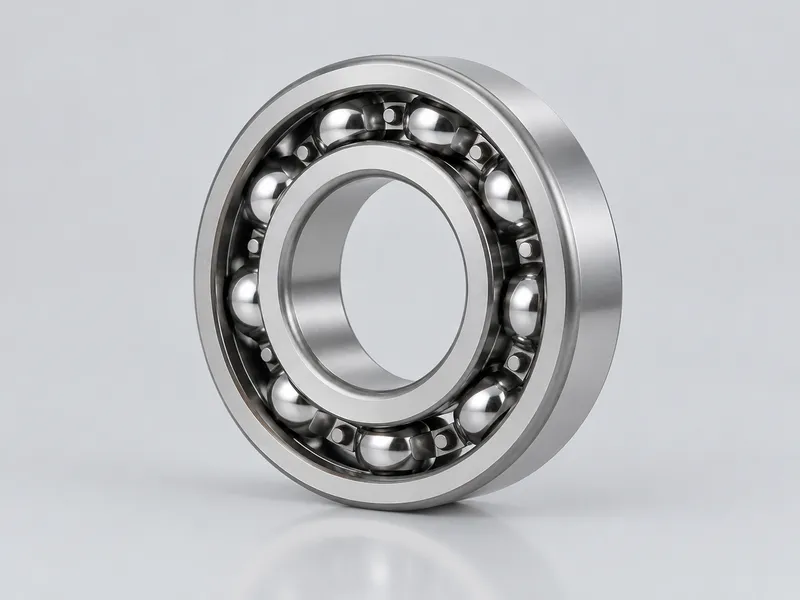
6800 series dimension and load range
| Attribute | Range across published models |
|---|---|
| Bore diameter (d) | 10 – 100 mm |
| Outside diameter (D) | 19 – 125 mm |
| Width (B) | 5 – 13 mm |
| Basic dynamic load rating (Cr) | 2.15 – 24.5 kN |
| Basic static load rating (C0r) | 0.84 – 21.2 kN |
Each span is the minimum and maximum over the 20 published model pages listed below, whose values are model-bound catalog figures traceable to a collected source. The series page adds no numbers of its own; a designation not listed here is not yet published with evidence, and we confirm it at quotation on request.
Published 6800-series models
Every designation below links to its own specification page — dimensions, load ratings, speeds and ordering notes per model.
Choosing inside the 6800 series
The 618xx series is the extra-thin end of the deep groove line: at the same bore its rings are significantly smaller and narrower than the 60, 62 and 63 series (CW Bearing thin-wall series note, collected 2026-11-16). That section is the entire purchase case — the smallest envelope and rotating mass of any series published on this site — and it is also the ceiling: the least steel between raceway and shaft means the lowest capacity and the least section rigidity in the family.
When is the extra-thin section the right answer?
Choose 618xx when the housing bore is fixed, the shaft is already as large as it can be, and the duty is light to moderate — that is the regime the thin-wall series exists for (CW Bearing, collected 2026-11-16). When load capacity dominates the requirement, a heavier section at the same bore is the honest answer even if it costs redesign work: capacity lost to section height cannot be recovered by bearing quality, and a 618xx running near its limit fails early no matter how well it is mounted.
What does an out-of-round housing do to the ring?
Thin rings take the shape of their seats (Silverthin thin-section mounting guidance, collected 2026-11-16). A housing bore outside roundness limits is reproduced by the outer ring: the ring follows the oval, internal clearance closes at the pinch, ball loads rise there, and the symptoms downstream are drag, heat and early fatigue rather than anything the catalog rating predicted (BearingMaker thin-section housing-design guide, collected 2026-11-16). Keep housing roundness within the bearing's radial runout order and seat-face flatness within its axial runout order — on this series those tolerances belong in the drawing, not in the fitter's discretion.
How do you verify and mount a ring this thin?
Incoming inspection cannot use two-point tools: a free-state thin ring is not round, so calipers and micrometers cannot yield a usable diameter — incoming checks need a multi-position method (CMM or air gage) with readings averaged (Silverthin mounting guidance, collected 2026-11-16). A press fit alone is never a mounting method on this series: rings must be clamped positively, with many small fasteners tightened in a star pattern; if pressing is unavoidable, push only through the ring being installed and never through the raceways (Silverthin mounting guidance, collected 2026-11-16).
When is a thin section the right family at all — and what does it give up?
The thin-section regime is space and weight, not load: the family exists for applications where space is limited, weight is a concern, and the loading and torque requirements still call for a ball bearing; one common industry definition puts the line at a bore more than four times the radial cross section (Design World thin-section selection explainer, collected 2026-11-16). The compromise is explicit: minimizing the ring section forces smaller balls, which costs load capacity — thin sections still carry moderate radial, thrust or combined loads, but they are not a capacity play (Design World, collected 2026-11-16). Where the bore has to pass wiring or tubing, or where a joint must articulate smoothly at minimum mass, that trade is usually worth it; where duty cycles are long and loads are real, the honest answer is a bigger section, not a better thin one.
What does the assembly environment owe an extra-thin ring?
Cleanliness and force discipline matter more here than on any standard section: precision thin-section bearings should be assembled at a clean work station with tools and mating parts free of burrs, dirt and chips, and kept in original factory packaging until installation (Design World thin-section installation guidance, collected 2026-11-16). Thermal fitting is the preferred way to achieve the interference without installation force; where pressing is used, the press tool must contact the ring being pressed over its full face, and force is never transmitted through the balls to the rings (Design World, collected 2026-11-16).
How much should you trust the load rating printed for this series?
Treat thin-section dynamic ratings as comparative, not absolute: the standard dynamic-rating equations are built on assumptions many of which are not valid for thin-section bearings, yet many thin-section catalogs still publish ratings computed from those equations (DYZV Bearing engineering note, collected 2026-11-16). Suppliers who rate thin sections from contact-stress and stress-cycle test programs exist, and their numbers can differ from equation-derived catalog figures (DYZV Bearing, collected 2026-11-16). When the duty is near the rating — which on this extra-thin series it often is — ask which basis the catalog number comes from, and give static margin the heavier weight in the check.
If the duty looks marginal at 618xx proportions — load creeping up, longer duty cycles, or a housing that cannot be held round enough — the 6900 series is the next section step at the same bore. Compare the two range tables and the two model sets before freezing the housing drawing; the section difference between the two is exactly the margin you are buying.
For the type-level overview see the deep groove ball bearings family page, or the standard model index for every published designation across all families.