
Deep groove ball bearings
6000 Series (extra light) — Deep Groove Ball Bearings
The 6000 series shelf: 27 published designations, each with its own model-bound specification page. The ranges below are the span across exactly those published models — not a family-wide promise. Open a designation for its full table, or send the designation you need with your application details.
Last updated: 2026-11
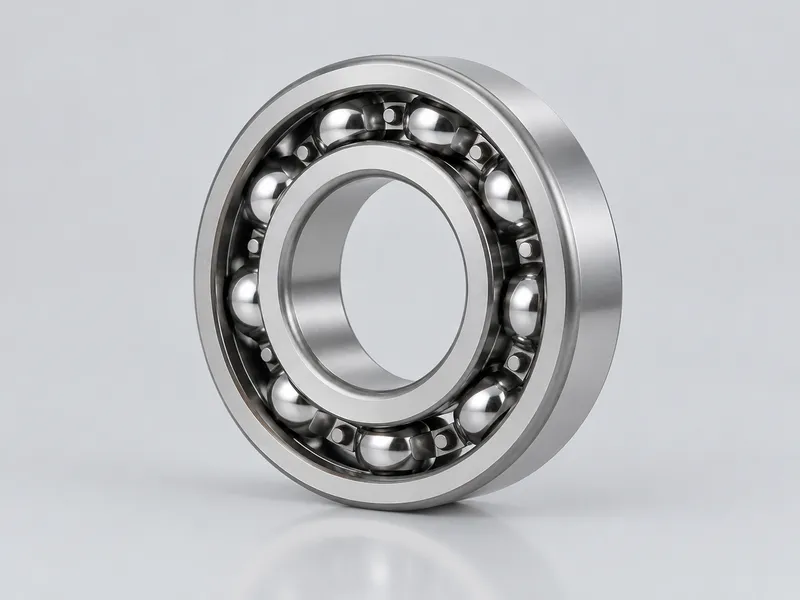
6000 series dimension and load range
| Attribute | Range across published models |
|---|---|
| Bore diameter (d) | 10 – 150 mm |
| Outside diameter (D) | 26 – 225 mm |
| Width (B) | 8 – 35 mm |
| Basic dynamic load rating (Cr) | 5.7 – 157 kN |
| Basic static load rating (C0r) | 1.95 – 126 kN |
Each span is the minimum and maximum over the 27 published model pages listed below, whose values are model-bound catalog figures traceable to a collected source. The series page adds no numbers of its own; a designation not listed here is not yet published with evidence, and we confirm it at quotation on request.
Published 6000-series models
Every designation below links to its own specification page — dimensions, load ratings, speeds and ordering notes per model.
Choosing inside the 6000 series
The 60 series is the slim end of the standard deep groove line: it shares the bore code with 62xx and 63xx but wraps it in the smallest outside diameter and width of the three (Compel Group size-chart series note, collected 2026-11-16). That envelope is what you are buying here — the narrowest standard-section answer at a given shaft — and it is also the boundary condition: capacity that a wider section would have carried is capacity this series does not have.
When is the slim section the right pick, and when is it the wrong one?
Pick 6000-series when the housing is tight in diameter or axial space and the duty is light — it is the slim choice for a tight radial envelope (Compel Group, collected 2026-11-16). Where the housing bore is already cut larger and space is open, the same shaft is served with more margin by 62xx or 63xx; specifying the slim section into a roomy housing only narrows the capacity you ship for no gain. The honest check is which dimension is actually fixed: the shaft is fixed on all three series, the housing usually is not (Fuli Bearings series-selector guidance, collected 2026-11-16).
Can a 6000-series bearing be swapped for a 62xx or 63xx on an existing machine?
Only when the housing agrees: the three series are not interchangeable in the same housing bore, and the outside diameter must be measured before ordering a replacement in a different series (Fuli Bearings, collected 2026-11-16). Stepping up needs the housing bore re-machined or already sized for the larger series; stepping down fits the bore but gives up load capacity, which converts a space-saving swap into an early failure if the load estimate does not fall with it (Compel Group cross-reference note, collected 2026-11-16).
Which closure keeps this series' speed advantage?
The slim section is often chosen for speed or low torque, so the closure choice matters more here than on heavier sections: metal shields add no drag and leave the maximum speed unchanged, while contact seals lower the maximum speed by about 40 percent and raise running torque sharply (Qogori closure comparison, collected 2026-11-16). Keep ZZ — or an open execution with housing-side sealing where relubrication is planned — when speed is the point; a 2RS on a fast slim-section position spends the very margin the series was picked for. Shields are not seals, though: fine dust and moisture pass the shield gap, so a dirty or washed-down duty belongs on contact seals at whatever speed cost the duty can afford (Qogori, collected 2026-11-16).
Which ring gets the tight fit when the load rotates?
Follow the rotation of the load, not the convenience of the assembly: where the load rotates with the inner ring — the normal case in motors and gearboxes — the inner ring needs an interference fit (k, m, n, p or r shaft classes) while the outer ring can sit in a clearance fit, and where the load rotates with the outer ring the recommendation reverses (JTEKT fit-selection guidance, collected 2026-11-16). Fit selection also has to weigh operating temperature, the internal clearance class, and the mounting and dismounting method together, because they interact (JTEKT, collected 2026-11-16). On a slim section this matters twice: the rings are thin enough that a fit chosen by habit rather than by load rotation distorts the running geometry the series was picked to deliver.
Does a higher precision class make this slim series better?
Not by itself: ABEC ratings are strictly dimensional and form standards — they say nothing about speed limits, noise, or material quality, and a higher precision bearing is not necessarily better for every application; because cost typically rises with precision, over-specifying the class is an unnecessary project cost (GlobalSpec bearing-tolerances explainer, collected 2026-11-16). The class should be picked from the rotation accuracy the shaft actually needs at the support point, with the class ladders across ABEC and the ISO/DIN/JIS systems mapped one-to-one so the requirement can be translated between standards (ISK Bearing precision-grade guidance, collected 2026-11-16). For a slim-section position chosen for envelope rather than spindle duty, the standard class usually is the honest answer.
What does the lubrication answer cost over the life of the position?
This series is often chosen for speed or low torque, which is exactly where sealed-for-life executions look attractive — but a sealed bearing cannot be relubricated, so the grease it ships with is the only grease it will ever have (EASA motor-lubrication guidance, collected 2026-11-16). Where the duty is long-hours and the machine is serviced anyway, an open or shielded execution with a housing-side grease point keeps a relubrication path alive; where it is genuinely sealed-for-life duty, the closure question above decides on speed alone. Either way the lubrication decision belongs to the same conversation as the closure decision, not after it.
Confirm the bore code in the range table, then check the housing before the designation: on this series the envelope decision and the closure decision carry more of the outcome than any catalog number. Each published model below carries its own evidence-backed dimension and load table.
For the type-level overview see the deep groove ball bearings family page, or the standard model index for every published designation across all families.
Failure modes in service — 6000 series
The extra-light 6000 section is built for speed and tight spaces, not for abuse: thin rings mean the fit, the mounting practice and the lubricant carry more of the reliability than they do in heavier sections. The failure modes below are the ones that actually end light-series deep groove bearings early — none of them are sorted by a bigger load rating, and all of them are cheaper to prevent than to replace.
Fretting corrosion and false brinelling
False brinelling is damage in the rolling contact that happens while the bearing is stationary and loaded: cyclic vibration breaks through the lubricant film, metal-to-metal contact corrodes, and shallow depressions form at the rolling-element pitch — dull, often reddish, occasionally shiny (SKF bearing-damage documentation). A small part counts as "stationary" long before it counts as shut down: micro-movements of a few micrometers between abutting surfaces are enough to initiate fatigue cracking, and transport or idle vibration of stored machines produces the same marks (false brinelling) that a single shock leaves as true brinelling — reddish-brown fretting debris means vibration during standstill, clean metallic indentations mean impact.
Where the fit is too loose for the load, the same microslip moves to the ring seats: reddish-brown oxide debris — easily mistaken for rust — appears on the inner-ring bore or outer-ring OD, and because fretting corrosion concentrates stress at the ring surface it is a recognised pathway to ring fracture, not a cosmetic issue. On an extra-light section, where the rings are compliant and seats are often marginal by design, this is the mode to check first when a 60xx bearing that ran fine is found with reddish dust around the housing.
Electrical erosion (fluting) in driven equipment
When stray current passes through a rolling bearing it machines the contact surfaces like a series of micro-welds: high current density at each ball crossing tempers or melts the material, leaving craters; continuous low-intensity leakage — the typical case on variable-frequency-drive motors without proper shaft grounding — erodes thousands of micro-craters that align into the washboard pattern called fluting (SKF and Schaeffler damage documentation; classified as its own damage mode in ISO 15243). A darkened, grey-to-black grease is a common tell before the raceway is inspected.
The countermeasures are electrical, not lubrication: an insulated or ceramic-hybrid bearing on the affected end, a shaft grounding ring, and correct earthing — a grease change will not stop current. If your 60xx-series position runs on a VFD, say so in the inquiry; we treat it as a selection condition, not an afterthought.
Cage fracture
The cage carries essentially no load — it only spaces the balls — so a fractured cage is almost always a secondary failure, and the investigation belongs to whatever stressed it: vibration, frequent starts, contamination wedged into the pockets, or lubrication that had already failed. One primary mechanism is specific to duty: equipment whose speed changes rapidly subjects the cage to high inertial loads, which can fatigue a cage to end-of-life even with no raceway spall present — the documented fix is a more robust cage design, which is a selection decision, not a repair.
Exceeding the published limiting speed is another cage-ending route: running a standard catalogue bearing past its speed limit without precision-class measures risks cage failure and seizure. The 6000 series earns its high speed ratings with light cages — respect the per-model limiting speeds on the linked pages.
Lubrication and contamination
Lubrication problems are among the most common causes of premature bearing failure: lost lubricant (missed regreasing intervals), the wrong grease for the duty, over-greasing (which overheats — mainly in open bearings), and ordinary grease degradation such as base-oil separation. Grease life falls as speed and size rise; at DN values near the grease limits, time-to-failure typically halves, partly because centrifugal force throws grease off the cage and raceway surfaces — a mode the high-speed 6000 series lives closest to.
Contamination compounds this both directly (particles dent raceways and those dents spall early) and indirectly, by degrading the lubricant until the failure looks lubrication-related; water is a special case, where even traces in the oil roughly halve fatigue life. Sealed and shielded executions of the same designations retain grease and block particles, but the grease still ages — monitoring does not stop being necessary.
Fits, mounting and clearance
Deep groove bearing capacity assumes near-perfect alignment: ratings are calculated on the basis that misalignment stays around 0.0005 rad (0.03°), and more than that yields less than the calculated life — the extra-light section has the least margin of the deep groove families here. On the seats themselves, the failure logic is symmetric: a fit too tight raises friction and heat; a fit too loose lets the ring creep, which destroys the interference and leaves fretting corrosion on the shaft journal — a condition that needs shaft repair before any new bearing is fitted.
Mounting practice is part of the specification: force applied with a hammer or through the wrong ring brinells the raceways and is a classic cause of early noise; interference fits are mounted with a press or by heating the ring (induction heater), never by brute force. And because a warm shaft expands faster than its housing dissipates heat, running temperature eats internal clearance — a fit-and-clearance combination that leaves no operating clearance can preload the bearing, overheat it and seize. The designation-level boundary and abutment dimensions on each linked page are the starting point for these checks.
For the full damage atlas behind this section see our bearing failure modes overview with photographic identification, and for execution-level trade-offs (open, ZZ, 2RS) the 2RS vs ZZ sealed bearings explainer. Every designation above links to its own page with the model-bound dimensions, ratings and limiting speeds these checks apply to.