
Cylindrical Roller Bearings
Cylindrical roller bearing NU1017
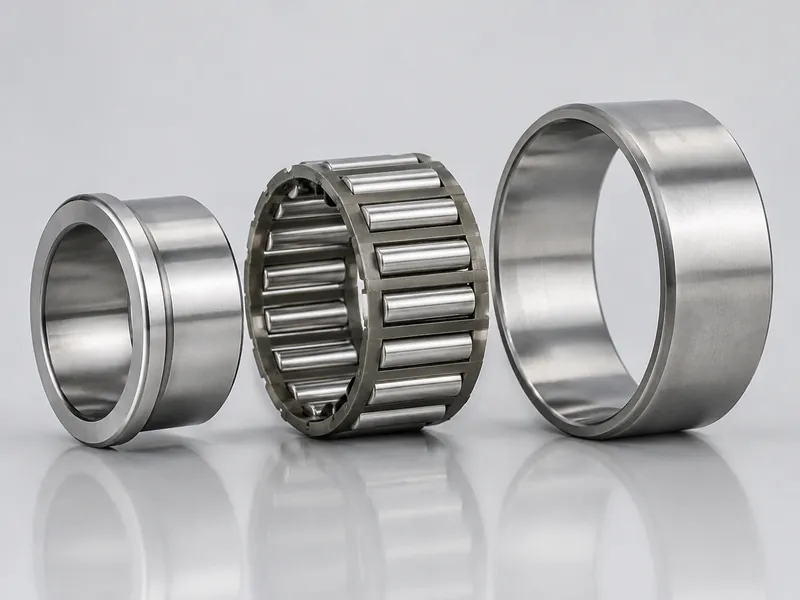
Cylindrical roller bearing NU1017, single-row NU (outer ring with two flanges, inner ring without flanges), boundary dimensions 85 mm × 130 mm × 22 mm. Specifications below are model-bound published values; the source class is identified for each parameter. Send your application details through the RFQ for a confirmed quotation.
Last updated: 2026-11
Specifications
| Specification | Value | Parameter class | Source publisher |
|---|---|---|---|
| Bore diameter (d) | 85 mm | Model designation & boundary dimension | jtekt.co.jpManufacturer-published specification |
| Outside diameter (D) | 130 mm | Model designation & boundary dimension | jtekt.co.jpManufacturer-published specification |
| Width (B) | 22 mm | Model designation & boundary dimension | jtekt.co.jpManufacturer-published specification |
| Minimum chamfer (r min.) | 1.1 mm | Model designation & boundary dimension | jtekt.co.jpManufacturer-published specification |
| Roller complement diameter (Fw) | 96.5 mm | Manufacturer catalog reference — not a supply guarantee | jtekt.co.jpManufacturer-published specification |
| Basic dynamic load rating (Cr) | 89.8 kN Basic dynamic load rating is a catalog reference used in bearing-life calculations; confirm equivalent load, speed, reliability and required service life for the application. | Manufacturer catalog reference — not a supply guarantee | jtekt.co.jpManufacturer-published specification |
| Basic static load rating (C0r) | 91.2 kN Basic static load rating is a catalog reference; verify equivalent static load and the required static safety factor for the application. | Manufacturer catalog reference — not a supply guarantee | jtekt.co.jpManufacturer-published specification |
| Fatigue load limit (Cu) | 12 kN Fatigue load limit is a catalog reference, not a standalone allowable-load or service-life guarantee; verify application duty and lubrication conditions. | Manufacturer catalog reference — not a supply guarantee | jtekt.co.jpManufacturer-published specification |
| Limiting speed, grease lubrication | 5100 min-1 Catalog limiting speed for grease lubrication, not an application operating recommendation. Confirm lubricant, temperature, load, sealing and duty conditions before selection. | Manufacturer catalog reference — not a supply guarantee | jtekt.co.jpManufacturer-published specification |
| Limiting speed, oil lubrication | 6000 min-1 Catalog limiting speed for oil lubrication, not an application operating recommendation. Confirm lubricant, temperature, load, sealing and duty conditions before selection. | Manufacturer catalog reference — not a supply guarantee | jtekt.co.jpManufacturer-published specification |
| Reference mass | 1.04 kg | Manufacturer catalog reference — not a supply guarantee | jtekt.co.jpManufacturer-published specification |
Parameter classes: Model designation & boundary dimension — what identifies the model (boundary dimensions follow the designation). Manufacturer catalog reference — the named manufacturer's published catalog data for this designation; it is not a guarantee that every unit we supply reaches these exact figures. Industry reference — a third-party or industry-published value; it is not specific to the named manufacturer and is not a supply guarantee. Supplier-confirmed — a value we have confirmed for our own supply. Order-confirmed — the value fixed in a specific order. None of the values on this page are supplier-confirmed yet; supply-specific figures (tolerance class, clearance, seal variant availability, lead time) are confirmed with your quotation.
The source publisher shown on each row identifies where that parameter was published; it is not necessarily the manufacturer supplying your order. Manufacturer-published specifications are linked where the source is approved for public linking. Industry-reference publishers are shown as text.
All values above are model-bound catalog values traceable to a collected source. Fields without collected evidence are not published; ask with your inquiry and we confirm them at quotation.
Manufacturer / model attribution: Koyo / JTEKT — NU1017 (single-row NU (outer ring with two flanges, inner ring without flanges)). This is the manufacturer named by the model-evidence record; it does not establish that every item supplied for an inquiry comes from this manufacturer. The actual manufacturer, original model and supplying source are confirmed in the quotation.
Source per specification field
| Specification | Source |
|---|---|
| Bore diameter (d) | jtekt.co.jp — manufacturer-published specification |
| Outside diameter (D) | jtekt.co.jp — manufacturer-published specification |
| Width (B) | jtekt.co.jp — manufacturer-published specification |
| Minimum chamfer (r min.) | jtekt.co.jp — manufacturer-published specification |
| Roller complement diameter (Fw) | jtekt.co.jp — manufacturer-published specification |
| Basic dynamic load rating (Cr) | jtekt.co.jp — manufacturer-published specification |
| Basic static load rating (C0r) | jtekt.co.jp — manufacturer-published specification |
| Fatigue load limit (Cu) | jtekt.co.jp — manufacturer-published specification |
| Limiting speed, grease lubrication | jtekt.co.jp — manufacturer-published specification |
| Limiting speed, oil lubrication | jtekt.co.jp — manufacturer-published specification |
| Reference mass | jtekt.co.jp — manufacturer-published specification |
Applications and selection notes
Cylindrical roller bearings carry high radial load at high speed and, in the separable executions, allow the ring with the roller-and-cage assembly to be mounted independently — which simplifies mounting on and removal from the shaft. Typical service: electric motors, machine-tool spindles, traction motors, crushers and gearboxes where radial capacity and stiffness matter more than axial capacity.
The NU execution (N205, NU2305 on this site) has two integral flanges on the outer ring and none on the inner, so it takes no axial load and permits free axial displacement of the shaft relative to the housing — the usual non-locating position. The N execution places the flanges the other way round with the same floating function.
How to read the specification table
Read the load ratings and limiting speeds in the table as designation-bound catalog values. Because the type is usually paired with a separate locating bearing, the position’s axial behaviour — not the radial rating — is what the selection hinges on. Confirm which ring displaces, and match the internal clearance to the fit and thermal gradient between shaft and housing.
The execution suffix in the designation states the flange arrangement, and with it the axial behaviour: NJ carries two integral flanges on the inner ring, so it locates the shaft axially in one direction against a housing shoulder while the outer ring still floats; NUP adds a loose rib-flange washer on the inner ring, giving axial location in both directions within the clearance it sets — the compact single-bearing locating execution. Match the suffix to the position’s locating duty before comparing ratings: substituting NU for NJ (or the reverse) changes the axial function of the position, not just the part number.
Large-bore and high-capacity positions often use the double-row NN and NNU executions for radial stiffness rather than single-row picks scaled up; the same flange logic applies per execution. Where the catalog lists a designation whose suffix you cannot match to your position’s axial duty, send the shaft/housing arrangement with the RFQ instead of guessing the execution.
Do not treat CM as a universal cylindrical-roller clearance equivalent to C3, or assume that two brands’ CM suffixes are automatically interchangeable. For a cylindrical-bore bearing with 24 < d ≤ 30 mm (for example, a 25 mm bore), NSK lists motor-bearing CM at 15–30 μm and the separate C3 class at 35–60 μm; NTN publishes the same two bands in its motor CM and interchangeable C3 tables. The ranges do not overlap. NSK further distinguishes interchangeable motor clearance CT (15–35 μm) from non-interchangeable CM (15–30 μm), while NTN explicitly warns that cylindrical-roller CM clearance is not interchangeable. The matching CM numbers across these two catalogues therefore do not establish cross-brand or component-level interchangeability. CM is a motor-application clearance category, not a substitute label for C3; choose it only after checking the actual fit, speed/load and temperature conditions, because installation interference and the inner/outer-ring temperature difference change the operating clearance. For an RFQ, state the exact maker and full designation, cylindrical or tapered bore, CT/CM/C3 class, required pre-mount radial-clearance band, measuring-load correction and batch inspection evidence, shaft/housing fits, and operating temperature difference. Do not approve a CM-for-C3 substitution from the suffix alone.
Separate axial location from axial thrust capacity when selecting NU, NJ and NUP cylindrical roller bearings. NU has no inner-ring ribs and is a floating-end design: it permits axial displacement between the rings but does not carry axial load. NJ locates in one direction; NUP uses a loose inner-ring rib to locate in both directions, and that loose rib must be retained axially. These are different shaft-location functions, not interchangeable suffixes. A change from NU to NJ/NUP changes the load path and the shaft locating scheme; a change from NJ to NUP adds the opposite locating direction but does not by itself establish a safe continuous thrust rating.
The axial load in NJ/NUP designs passes from the roller end faces to the ring ribs through a sliding contact. The resulting friction can cause heat, wear, smearing at the flange contact, disturbed roller kinematics or flange damage. Therefore Cr and C0r are radial-bearing ratings and cannot be used as the allowable axial thrust of an NJ/NUP bearing. Fixed-end or locates-in-both-directions describes the position function; it is not a promise that the bearing can carry a large, reversing or continuous thrust load. NU is not a fallback for an axial-loaded position: NTN explicitly states that NU cannot receive axial load.
There is no universal cross-maker axial-load formula. SKF’s published method uses the exact bearing’s C0, actual radial load, rotational speed, bore/outside diameters and SKF-specific factors for design and lubrication; its stated normal-condition basis includes a 60 °C bearing-to-ambient temperature difference, viscosity ratio κ ≥ 2 and misalignment no greater than 1 arcminute. NTN’s handbook instead relates allowable axial load to a design factor, bore diameter and permissible rib surface pressure selected against roller pitch diameter × speed and lubrication. JTEKT/Koyo uses duty, diameter-series and rib-surface-pressure factors, with the latter dependent on mean diameter × speed and lubrication. NSK’s application guidance also requires radial load alongside thrust, adequate lubricant at roller ends/ribs, running-in, accurate mounting and clearance no greater than necessary. These are manufacturer-specific methods and boundaries; do not transfer a coefficient or calculated kN value from one brand to another.
Before quoting or approving an NJ/NUP substitute, state the exact manufacturer, series, full designation and rib/loose-rib execution; continuous, intermittent and peak axial loads with direction and reversal; simultaneous radial load; inner-ring speed; grease or oil type and delivery method; operating temperature and heat dissipation; shaft/housing alignment and mounting accuracy; radial clearance; and duty cycle. Ask the selected manufacturer to calculate permissible axial load for that exact bearing and lubrication condition, identify the calculation method and its assumptions, and confirm the loose rib retention and axial fixing details. If the load is substantial, reversing, or outside the published method, obtain a manufacturer application calculation or design a separate thrust-load path rather than treating NUP as a general-purpose thrust bearing.
NUP is a two-direction locating execution, not a universal axial-endplay specification. SKF’s NUP 2 size-code 08 row (40 mm bore) gives 47–155 μm axial internal clearance; SKF labels the table values as guidelines because roller tilt can enlarge the measured value, and for series 2 the enlargement can be approximately the radial clearance. This axial-clearance figure is not the radial CN/C3 class and must not be copied as a guaranteed assembled shaft endplay. For a replacement, request the exact maker’s axial-clearance range, measurement method and the assembled endplay target separately.
The NUP208 cross-maker check shows why “NUP208 + 40 × 80 × 18 mm” is only an envelope screen: SKF NUP 208 ECP, NSK NUP208EM and NTN NUP208EAT2XU publish different cage executions and different Cr/C0r values (62/53, 68.5/55.5 and 66/55.5 kN respectively); these are manufacturer ratings, not comparative test results or a brand ranking. Their shoulder data also remains execution-specific: NSK explicitly says that when axial load is applied, da must be increased and Da reduced from the drawing values. SKF notes that a heavily loaded locating position may be better served by NJ + HJ where a full-width inner-ring seat is needed, because NUP has a shorter inner ring and a loose flange. Before approving a substitute, confirm the full designation and cage, axial internal clearance and measurement method, loose-flange drawing/retention, shaft and housing abutments/fillets, actual axial load spectrum and required assembled endplay; do not approve on NUP code and boundary dimensions alone.
Related engineering knowledge
Background reading that supports the selection decision on this page — failure modes, seal trade-offs and lubrication behavior. These articles explain the engineering; the specifications and supply commitments live on this page and in the quotation.
NU1017 — buying questions
What does the designation NU1017 mean?
NU1017 is a standard boundary-dimension designation: the dimension series fixes the outside diameter and width proportions, and the bore code fixes the bore diameter — 85 mm for this bearing. Two bearings carrying the same designation from conforming manufacturers are dimensionally interchangeable; execution (seals, clearance class, cage) is the part that can differ, so state the execution you need when you request a quotation.
Are the catalog load rating and speed of NU1017 enough for my application?
The table lists Basic dynamic load rating (Cr) = 89.8 kN and grease-lubricated limit 5100 min-1 and oil-lubricated limit 6000 min-1. The load rating is the starting point of a life calculation, and each speed is a catalog limit for the manufacturer’s execution, not an application operating recommendation. Seals, fits, temperature and lubrication all affect the usable speed in a real assembly. Both lubricant-specific limits are listed; compare each only under its stated lubricant and manufacturer execution. Send the application conditions with your inquiry and we confirm suitability before quoting; do not size from the catalog speed alone.
What information do you need to quote NU1017?
Four things, in one message: the designation (and execution — seals, clearance class, precision class, if not standard), the quantity, the destination country, and any documents you require. Application conditions such as speed, load direction and temperature are welcome and let us verify the execution instead of assuming it. Quotation, lead time and the exact document set come back in writing.
Ordering & documentation
Documents
The documents available for NU1017 depend on the actual supplying source and order. State any required export, origin, material or inspection documents in your inquiry; the available document set is confirmed in writing with the quotation.
Quotation
To quote NU1017, send: the designation and required execution, quantity, destination country, and any required documents. Adding the application conditions (speed, load direction, temperature, fit) lets us confirm the execution and clearance class instead of quoting blind.
Sample & supply
If you need an evaluation sample of NU1017, state the required quantity and timing. Sample feasibility, source, price and dispatch timing are confirmed in the quotation; sample availability is not assumed from the standard designation alone.
Lead time for this designation and quantity is confirmed in the quotation against the actual supplying source and availability. Any applicable certificates and quality documents are confirmed for the actual supplying source and product; available documents are stated in the quotation.
Storage & shipping
Store bearings flat in their original, unopened packaging in a dry indoor area away from temperature swings. Confirm the actual preservation method, packaging, marking and transport protection for the supplying source and order before shipment. Do not rotate a bearing through its rolling elements during handling or mounting.