
Tapered Roller Bearings
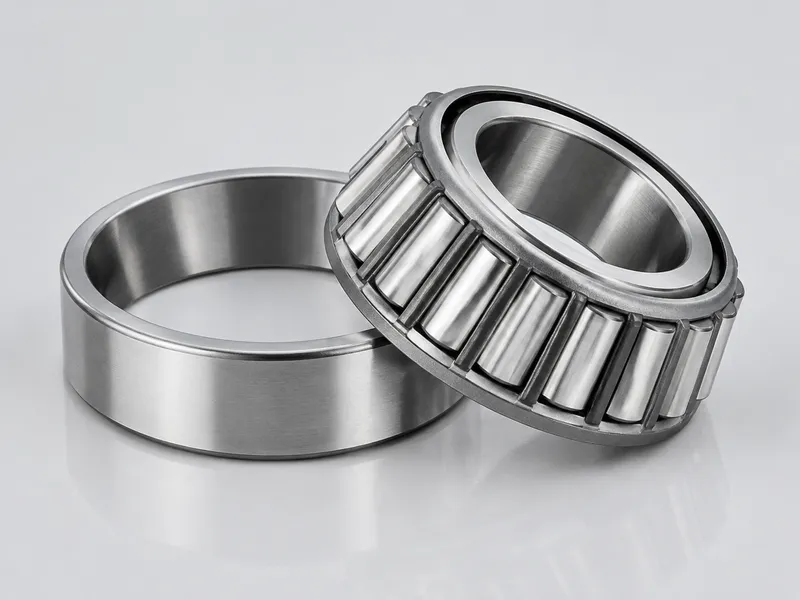
Tapered roller bearing 32338
Tapered roller bearing 32338, single-row, metric series, pressed cage, boundary dimensions 190 mm × 400 mm × 140 mm. Specifications below are model-bound published values; the source class is identified for each parameter. Send your application details through the RFQ for a confirmed quotation.
Last updated: 2026-11
Specifications
| Specification | Value | Parameter class | Source publisher |
|---|---|---|---|
| Bore diameter (d) | 190 mm | Model designation & boundary dimension | koyo.jtekt.co.jpManufacturer-published specification |
| Outside diameter (D) | 400 mm | Model designation & boundary dimension | koyo.jtekt.co.jpManufacturer-published specification |
| Basic dynamic load rating (Cr) | 1940 kN Basic dynamic load rating is a catalog reference used in bearing-life calculations; confirm equivalent load, speed, reliability and required service life for the application. | Manufacturer catalog reference — not a supply guarantee | koyo.jtekt.co.jpManufacturer-published specification |
| Limiting speed, grease lubrication | 890 min-1 Catalog limiting speed for grease lubrication, not an application operating recommendation. Confirm lubricant, temperature, load, sealing and duty conditions before selection. | Manufacturer catalog reference — not a supply guarantee | koyo.jtekt.co.jpManufacturer-published specification |
| Limiting speed, oil lubrication | 1200 min-1 Catalog limiting speed for oil lubrication, not an application operating recommendation. Confirm lubricant, temperature, load, sealing and duty conditions before selection. | Manufacturer catalog reference — not a supply guarantee | koyo.jtekt.co.jpManufacturer-published specification |
| Reference mass | 76.6 kg | Manufacturer catalog reference — not a supply guarantee | koyo.jtekt.co.jpManufacturer-published specification |
| Shaft abutment diameter (da min.) | 218 mm | Model designation & boundary dimension | koyo.jtekt.co.jpManufacturer-published specification |
| Housing abutment diameter (Da max.) | 378 mm | Model designation & boundary dimension | koyo.jtekt.co.jpManufacturer-published specification |
| Overall width (T) | 140 mm | Model designation & boundary dimension | koyo.jtekt.co.jpManufacturer-published specification |
| Minimum chamfer (r min.) | 6 mm | Model designation & boundary dimension | koyo.jtekt.co.jpManufacturer-published specification |
| Fillet radius (r max.) | 5 mm | Model designation & boundary dimension | koyo.jtekt.co.jpManufacturer-published specification |
| Inner ring width (B) | 132 mm | Manufacturer catalog reference — not a supply guarantee | koyo.jtekt.co.jpManufacturer-published specification |
| Outer ring width (C) | 109 mm | Model designation & boundary dimension | koyo.jtekt.co.jpManufacturer-published specification |
| Basic static load rating (C0r) | 2190 kN Basic static load rating is a catalog reference; verify equivalent static load and the required static safety factor for the application. | Manufacturer catalog reference — not a supply guarantee | koyo.jtekt.co.jpManufacturer-published specification |
| Fatigue load limit (Cu) | 224 kN Fatigue load limit is a catalog reference, not a standalone allowable-load or service-life guarantee; verify application duty and lubrication conditions. | Manufacturer catalog reference — not a supply guarantee | koyo.jtekt.co.jpManufacturer-published specification |
Parameter classes: Model designation & boundary dimension — what identifies the model (boundary dimensions follow the designation). Manufacturer catalog reference — the named manufacturer's published catalog data for this designation; it is not a guarantee that every unit we supply reaches these exact figures. Industry reference — a third-party or industry-published value; it is not specific to the named manufacturer and is not a supply guarantee. Supplier-confirmed — a value we have confirmed for our own supply. Order-confirmed — the value fixed in a specific order. None of the values on this page are supplier-confirmed yet; supply-specific figures (tolerance class, clearance, seal variant availability, lead time) are confirmed with your quotation.
The source publisher shown on each row identifies where that parameter was published; it is not necessarily the manufacturer supplying your order. Manufacturer-published specifications are linked where the source is approved for public linking. Industry-reference publishers are shown as text.
All values above are model-bound catalog values traceable to a collected source. Fields without collected evidence are not published; ask with your inquiry and we confirm them at quotation.
Manufacturer / model attribution: Koyo / JTEKT — 32338 (single-row, metric series, pressed cage). This is the manufacturer named by the model-evidence record; it does not establish that every item supplied for an inquiry comes from this manufacturer. The actual manufacturer, original model and supplying source are confirmed in the quotation.
Source per specification field
| Specification | Source |
|---|---|
| Bore diameter (d) | koyo.jtekt.co.jp — manufacturer-published specification |
| Outside diameter (D) | koyo.jtekt.co.jp — manufacturer-published specification |
| Basic dynamic load rating (Cr) | koyo.jtekt.co.jp — manufacturer-published specification |
| Limiting speed, grease lubrication | koyo.jtekt.co.jp — manufacturer-published specification |
| Limiting speed, oil lubrication | koyo.jtekt.co.jp — manufacturer-published specification |
| Reference mass | koyo.jtekt.co.jp — manufacturer-published specification |
| Shaft abutment diameter (da min.) | koyo.jtekt.co.jp — manufacturer-published specification |
| Housing abutment diameter (Da max.) | koyo.jtekt.co.jp — manufacturer-published specification |
| Overall width (T) | koyo.jtekt.co.jp — manufacturer-published specification |
| Minimum chamfer (r min.) | koyo.jtekt.co.jp — manufacturer-published specification |
| Fillet radius (r max.) | koyo.jtekt.co.jp — manufacturer-published specification |
| Inner ring width (B) | koyo.jtekt.co.jp — manufacturer-published specification |
| Outer ring width (C) | koyo.jtekt.co.jp — manufacturer-published specification |
| Basic static load rating (C0r) | koyo.jtekt.co.jp — manufacturer-published specification |
| Fatigue load limit (Cu) | koyo.jtekt.co.jp — manufacturer-published specification |
Koyo / JTEKT 32338 — combined radial and axial load factors
JTEKT's product record for the exact single-row metric tapered roller bearing 32338 publishes the factors below. They help convert a combined radial / axial load into the equivalent load used for bearing selection; they are not standalone allowable loads or a substitute for checking the actual bearing arrangement.
| Manufacturer parameter | 32338 value | How it is used |
|---|---|---|
| Constant e | 0.35 | Boundary ratio used in the manufacturer's combined-load calculation |
| Axial load factor Y1 | 1.73 | Axial factor used in the applicable higher Fa/Fr load branch |
| Axial load factor Y0 | 0.95 | Static-equivalent-load factor; use with the manufacturer's static-load method |
| Load-centre spread a | 96.5 mm | Geometric input used when calculating axial component forces in a paired tapered-roller arrangement |
JTEKT's tapered-roller technical section defines dynamic equivalent load as P = XFr + YFa and states that the e boundary and the X/Y factors come from the bearing specification table. For single-row tapered roller bearings, radial loading also generates an axial component force; the catalogue therefore treats the bearings as a face-to-face or back-to-back pair and gives a separate paired-bearing calculation. Do not apply Y1 as a universal multiplier to Fa without first resolving the load branch and the opposite bearing's radial / axial reaction.
For static screening, JTEKT defines the radial-bearing static equivalent load as the greater of P0 = X0Fr + Y0Fa and P0r = Fr. The 32338 Y0 value is 0.95; the full X0/Y0 method and the actual bearing reactions must be used rather than comparing Fa directly with C0r.
These are Koyo / JTEKT catalogue factors for designation 32338 only. The product page lists Cr = 1,940 kN, C0r = 2,190 kN, Cu = 224 kN, grease / oil limiting speeds 890 / 1,200 min⁻¹, and load-centre spread a = 96.5 mm. Catalogue ratings and factors are not application-specific allowable loads or a life guarantee. Confirm the paired bearing designation and arrangement, external axial load, radial load at each bearing, speed, lubrication, operating temperature and required life before final selection.
Sources: Koyo / JTEKT official 32338 product record (model-specific e, Y1, Y0, load-centre spread and ratings); JTEKT Tapered Roller Bearings catalogue, printed pages 14–15, section 4 (dynamic and static equivalent-load method and paired single-row tapered-roller calculation).
Koyo / JTEKT 32338 — static-load safety coefficient screening
JTEKT publishes a basic static radial load rating (C₀r) of 2,190 kN for the exact single-row tapered roller bearing 32338. Its bearing-selection guidance assigns different minimum static safety coefficients to different operating conditions. The table converts those manufacturer thresholds into a model-specific preliminary static-equivalent-load ceiling.
| Operating condition (JTEKT) | Minimum static safety coefficient fₛ | 32338 screening ceiling for P₀ |
|---|---|---|
| Bearing rotating — high accuracy required | 3.0 | 730 kN |
| Bearing rotating — normal operation | 1.5 | 1,460 kN |
| Bearing rotating — impact load | 3.0 | 730 kN |
| Stationary / occasional oscillation — normal operation | 1.0 | 2,190 kN |
| Stationary / occasional oscillation — impact or uneven load distribution | 2.0 | 1,095 kN |
How to use the table: JTEKT defines the static safety coefficient as fₛ = C₀ / P₀. For this 32338 record, C₀r = 2,190 kN, so each screening ceiling is 2,190 kN divided by the applicable minimum fₛ. Compare the ceiling with the bearing's manufacturer-calculated static equivalent radial load P₀ — not with axial force alone or an unprocessed radial/axial vector sum.
Selection boundary: these are preliminary static-deformation screening limits based on JTEKT's stated minimum coefficients, not rated working loads, dynamic life limits, or a guarantee against impact damage. Calculate P₀ from the actual radial and axial reactions using the tapered-roller method and paired-bearing arrangement where applicable. If the load path, shock level, required smoothness or load distribution is uncertain, obtain an application-specific review rather than selecting from C₀r alone.
This calculation is specific to Koyo / JTEKT 32338 (C₀r = 2,190 kN). Do not transfer the resulting kN ceilings to another bearing designation or manufacturer, even where dimensions appear similar. The catalog rating is manufacturer reference data, not confirmation of the actual brand, batch or supply configuration for an order.
Sources: Koyo / JTEKT 32338 product detail (C₀r = 2,190 kN); JTEKT Basic Bearing Knowledge, section 5-5-3, Table 5-10 (static safety coefficient by operating condition and fₛ = C₀ / P₀).
Applications and selection notes
Tapered roller bearings carry combined radial and axial load, with the axial capacity sharing the same geometry as the radial capacity through the tapered raceways. They are supplied as a separable cup and cone, mounted opposed in single, double or multiple arrangements. Typical service: wheel hubs, gear reducers, mining and construction equipment, machine-tool spindles and steering systems.
The 3xxxx series on this page is the standard single-row inch/metric series; the contact angle grows through the series from light to heavy axial capacity. Because the two rings are separable, mounting sets the internal clearance mechanically — the application must specify the end-play or preload the assembly needs.
How to read the specification table
Unlike ball bearings, a tapered position is selected as an arrangement: two opposed single-row bearings, or a double-row execution, with the clearance set at assembly. The table’s ratings are catalog values for the single bearing; the arrangement’s capacity and stiffness follow from the mounting geometry. State the application’s axial demands and the target clearance in the RFQ so the offer matches the arrangement.
Do not calculate an opposed single-row tapered-roller pair by entering the externally measured radial load and external thrust directly into one generic P = XFr + YFa formula. A radial load on a tapered raceway creates an internal axial component because the contact line is inclined; the two bearings then share axial load according to their arrangement, individual radial reactions, external thrust direction and the bearing-specific axial factor. NTN’s 2024 worked example makes the consequence visible: for a 32907XU / 32908XU pair with calculated radial reactions 5.98 kN and 4.18 kN and no stated external thrust, NTN calculates FaI = 0 and FaII = 1.45 kN; the resulting equivalent radial loads are 5.98 kN and 4.67 kN. One row therefore carries induced axial load while the other does not. These are NTN’s example values for that arrangement, not transferable design constants.
The calculation methods are not interchangeable across manufacturers. SKF’s 2018 catalogue says its paired single-row axial-load equations apply when the bearings are adjusted to practically zero clearance but without preload, and when radial loads act at the bearing pressure centres; its table then branches by back-to-back / face-to-face arrangement and external axial force. NTN’s 2024 Table 4.7 states that its paired-bearing equations apply when preload is zero; its note does not state the same practically-zero-clearance condition as SKF, so that omission must not be read as approval for an arbitrary clearance setting. Timken’s 2017 Engineering Manual uses a different traditional approximation: it assumes a 180° load zone (half the rollers carrying load), defines induced thrust as Fa(180) = 0.47 Fr / K, and selects Table 7 equations by direct / indirect mounting and the direction of external thrust. Timken K is its tapered-bearing K-factor, not SKF/NTN’s Y factor; do not convert or compare the factors as if they were one common scale.
For a cross-brand replacement, first fix the actual assembly state, not just the bearing designation: identify DB / DF orientation (or direct / indirect mounting), which bearing is A/B or front/rear, radial reaction at each pressure/load centre, external axial force including reversal, and the cold and operating clearance or preload. Then require each quoted manufacturer to calculate the induced axial load on each row, each row’s equivalent dynamic and static load, and life using that manufacturer’s own factors and rating basis. If the pair has non-zero operating clearance, preload, unequal contact angles, a third support, or a load case outside the published table, stop using the simplified table and obtain a manufacturer-confirmed calculation or validated system analysis. Equal dimensions or a higher single-bearing Cr/C90 alone do not approve a pair-level substitute.
Related engineering knowledge
Background reading that supports the selection decision on this page — failure modes, seal trade-offs and lubrication behavior. These articles explain the engineering; the specifications and supply commitments live on this page and in the quotation.
32338 — buying questions
What does the designation 32338 mean?
32338 is a standard boundary-dimension designation: the dimension series fixes the outside diameter and width proportions, and the bore code fixes the bore diameter — 190 mm for this bearing. Two bearings carrying the same designation from conforming manufacturers are dimensionally interchangeable; execution (seals, clearance class, cage) is the part that can differ, so state the execution you need when you request a quotation.
Are the catalog load rating and speed of 32338 enough for my application?
The table lists Basic dynamic load rating (Cr) = 1940 kN and grease-lubricated limit 890 min-1 and oil-lubricated limit 1200 min-1. The load rating is the starting point of a life calculation, and each speed is a catalog limit for the manufacturer’s execution, not an application operating recommendation. Seals, fits, temperature and lubrication all affect the usable speed in a real assembly. Both lubricant-specific limits are listed; compare each only under its stated lubricant and manufacturer execution. Send the application conditions with your inquiry and we confirm suitability before quoting; do not size from the catalog speed alone.
What information do you need to quote 32338?
Four things, in one message: the designation (and execution — seals, clearance class, precision class, if not standard), the quantity, the destination country, and any documents you require. Application conditions such as speed, load direction and temperature are welcome and let us verify the execution instead of assuming it. Quotation, lead time and the exact document set come back in writing.
Ordering & documentation
Documents
The documents available for 32338 depend on the actual supplying source and order. State any required export, origin, material or inspection documents in your inquiry; the available document set is confirmed in writing with the quotation.
Quotation
To quote 32338, send: the designation and required execution, quantity, destination country, and any required documents. Adding the application conditions (speed, load direction, temperature, fit) lets us confirm the execution and clearance class instead of quoting blind.
Sample & supply
If you need an evaluation sample of 32338, state the required quantity and timing. Sample feasibility, source, price and dispatch timing are confirmed in the quotation; sample availability is not assumed from the standard designation alone.
Lead time for this designation and quantity is confirmed in the quotation against the actual supplying source and availability. Any applicable certificates and quality documents are confirmed for the actual supplying source and product; available documents are stated in the quotation.
Storage & shipping
Store bearings flat in their original, unopened packaging in a dry indoor area away from temperature swings. Confirm the actual preservation method, packaging, marking and transport protection for the supplying source and order before shipment. Do not rotate a bearing through its rolling elements during handling or mounting.